

Published by aakruthiproperties September 6, 2026
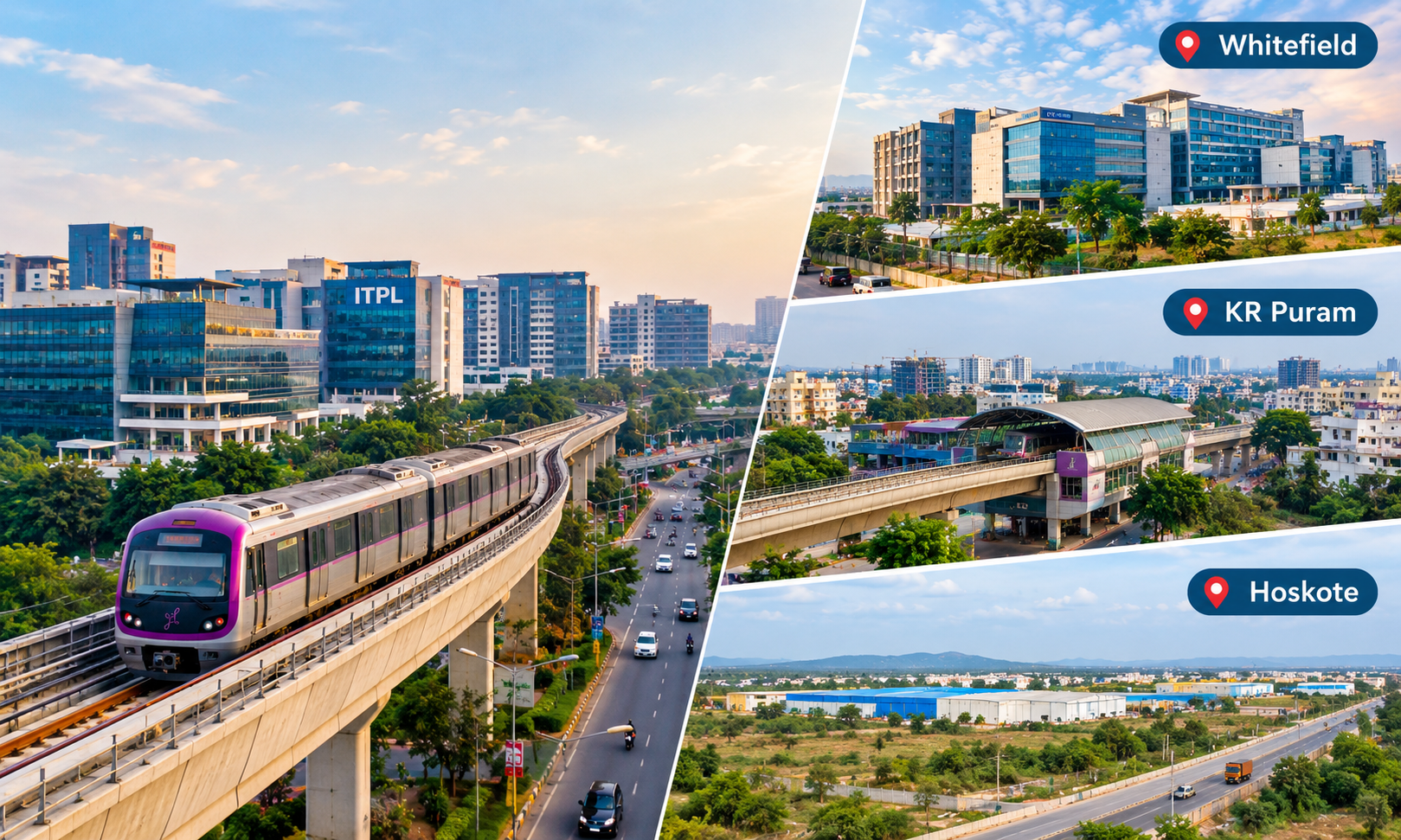
If you’ve started researching property in East Bangalore, you’ve probably noticed that every broker, every website, and every WhatsApp forward talks about “East Bangalore” as if it’s one single market. It isn’t. Whitefield today looks nothing like it did fifteen years ago, KR Puram is going through its own transformation because of a metro interchange that’s still under construction, and Hoskote is an entirely different animal – an industrial and logistics belt that’s only recently started attracting serious residential interest.
Treating these as interchangeable is where a lot of buyers go wrong. A techie who wants to walk to work in Whitefield has very different requirements from an NRI investor comfortable holding a Hoskote plot for eight to ten years, and both are different again from a family that wants a villa plot with room to build later. This guide walks through the individual corridors – what’s actually built, what’s genuinely coming, and what’s still just a proposal on paper – so you can match the location to your own situation instead of a generic sales pitch.
Why East Bangalore Is Attracting Property Buyers in 2026
East Bangalore’s pull comes down to one basic fact: it houses one of the city’s largest concentrations of jobs. The Whitefield–Mahadevapura belt is home to International Tech Park Bangalore (ITPL), EPIP Zone, Brookefield, and a long list of IT, engineering, and back-office campuses that employ hundreds of thousands of people. When a large employment base sits in one part of a city, housing demand around it tends to follow – that’s the core logic behind East Bangalore’s residential growth, not any single announcement or project.
On connectivity, the most important thing to understand is the Purple Line of Namma Metro, which now runs the full stretch from Whitefield (Kadugodi) in the east to Challaghatta in the southwest, covering 37 stations end to end. This section has been operational since March 2023, so when someone tells you Whitefield “has metro access,” that’s existing infrastructure, not a future promise.
Road connectivity is a mixed picture. The Outer Ring Road, Old Airport Road, and NH 75 (Old Madras Road) all pass through or near this belt, but traffic congestion – especially around KR Puram and Marathahalli – remains a genuine pain point that any serious buyer should experience firsthand before deciding. Kempegowda International Airport sits roughly 35–40 km from central Whitefield by road, and until the Blue Line’s airport link opens, that trip depends entirely on road traffic conditions.
It’s worth separating two categories clearly, because this distinction matters throughout this guide:
- Existing infrastructure: the Purple Line metro (Whitefield to Challaghatta), the ORR, NH 75/Old Madras Road, and established social infrastructure – hospitals, schools, malls – in Whitefield and parts of KR Puram.
- Future/planned infrastructure: the Blue Line airport metro, any Purple Line extension toward Hoskote, and the Bengaluru Business Corridor (the renamed Peripheral Ring Road project).
Keep that distinction in mind as you read the rest of this guide – a lot of East Bangalore’s investment narrative rests on the second category, and timelines for large infrastructure projects in India routinely slip.
Whitefield: Established IT and Residential Hub
Whitefield is the most mature of the three corridors covered here, and it shows in almost every metric.
Connectivity and metro access. Whitefield is the eastern terminus of the Purple Line, with multiple stations serving the area – Whitefield (Kadugodi), Kadugodi Tree Park, Pattandur Agrahara, Sri Sathya Sai Hospital, Nallurhalli, Kundalahalli, Seetharamapalya, and Garudacharpalya among them. This is genuinely one of the better metro-served micro-markets in Bangalore, and it’s been that way since March 2023, so residents have had a few years to build daily commuting habits around it.
Employment ecosystem. ITPL, EPIP Zone, and the broader Brookefield–Whitefield stretch host a dense mix of IT services companies, engineering firms (including aerospace and healthcare technology players), and back-office operations. This concentration of jobs is arguably Whitefield’s single biggest structural advantage – people don’t just buy here speculatively, they buy here to shorten their commute.
Social infrastructure. Whitefield has had years to develop hospitals, international schools, malls, and a large base of gated apartment communities. This maturity cuts both ways – it’s a genuine strength for someone who wants a fully “arrived” neighbourhood, but it also means Whitefield doesn’t offer the kind of ground-floor pricing that comes with an area still being built out.
Advantages: established metro connectivity, deep employment base, mature social infrastructure, strong resale liquidity for apartments.
Limitations: traffic congestion on internal roads and at junctions connecting to ORR remains a real issue; land and villa-plot inventory is limited and expensive compared to areas further east; much of the “new” Whitefield development has pushed further out toward Kadugodi and Hoskote Road precisely because central Whitefield land is scarce.
Villa/plot availability compared with apartments. Central Whitefield is now dominated by apartment stock – freestanding plots are hard to find and priced accordingly. Buyers specifically looking for villa plots tend to look toward the outer edges of Whitefield, along Hoskote Road, or in the corridors covered later in this guide.
Soukya Road: Whitefield’s plotted-development and villa corridor. One part of Whitefield that deserves its own mention is Soukya Road, which runs from the Hope Farm Junction area toward Hoskote and has increasingly become the stretch buyers look to specifically for villa plots and row villas rather than apartments. Because it sits just off central Whitefield, the corridor has attracted a steady pipeline of plotted developments and low-density villa projects in recent years, alongside a growing number of mid-rise apartment launches aimed at professionals working in the ITPL and EPIP belt. Road-widening work along Soukya Road has been underway to ease what is otherwise a fairly congested stretch, and its position between Whitefield and Hoskote means it benefits from proximity to both an established employment base and Hoskote’s expressway-driven industrial growth. As with any developing pocket, buyers should treat Soukya Road as a corridor still filling in rather than a finished one – infrastructure upgrades and any metro-related proposals for the area remain a work in progress, so the usual due-diligence steps around layout approval and access roads apply here as much as anywhere else in this guide.
Who should consider Whitefield: professionals who work in or near the area and want to minimize commute time, buyers prioritizing immediate liveability and social infrastructure over long-term appreciation potential, and investors comfortable with a more mature (and therefore more stable, less explosive) price trajectory.
KR Puram: Connectivity-Focused Growth Corridor
KR Puram (Krishnarajapuram) occupies a genuinely strategic position – it sits at the point where the established Whitefield belt meets the roads heading out toward Hoskote and, eventually, the Bengaluru–Chennai Expressway.
Metro and transport connectivity. This is KR Puram’s defining feature. The Krishnarajapura metro station is already operational on the Purple Line, but it’s also designated as a future interchange station for the Blue Line – the airport corridor connecting Central Silk Board to Kempegowda International Airport via Hebbal. That would make KR Puram one of only a handful of stations in the city where two major lines meet. As of mid-2026, however, the Blue Line’s Silk Board–KR Puram section has faced repeated timeline revisions, with different official statements at different points putting commercial operations anywhere from late 2026 to 2027; the KR Puram–Hebbal stretch, described as the most difficult segment, has been pushed further still. If you’re buying in KR Puram partly on the strength of the Blue Line, treat the exact opening date as genuinely uncertain and verify the latest BMRCL update before making a decision.
Strategic location. KR Puram sits on NH 44/Old Madras Road, giving it a direct road link toward Hoskote and the Bengaluru–Chennai Expressway, while also connecting back into Whitefield and the ORR. The KR Puram railway station adds a suburban rail option that some of the other corridors in this guide don’t have.
Employment accessibility. KR Puram doesn’t have Whitefield’s density of large campuses sitting directly within it, but its location gives residents reasonably fast access to Whitefield, Marathahalli, and (once the Blue Line opens) the ORR tech corridor – without the same land pricing as those established hubs.
Residential development. The area has a growing mix of mid-rise apartments and some plotted development, but it’s noticeably less “finished” than central Whitefield – social infrastructure, in particular, is still catching up to the pace of residential construction.
Advantages and limitations. The advantage is clear: KR Puram offers connectivity potential (both existing and future) at a price point generally below Whitefield. The limitation is equally clear: a meaningful part of that potential depends on infrastructure that is still under construction and has already slipped its original timeline more than once.
Suitability for end users versus investors. For end users who need to live near their workplace today, KR Puram’s traffic congestion around the junction area can be a genuine daily frustration, so it’s worth spending time in the area at peak hours before committing. For investors with a medium-to-long holding period who are comfortable waiting out the Blue Line’s construction timeline, KR Puram’s position at the junction of multiple transit and road corridors is a reasonable thesis – provided it’s treated as a multi-year bet, not a near-term one.
Hoskote: Emerging Growth Corridor
Hoskote has moved furthest, in relative terms, from its old identity as a quiet industrial town on Bangalore’s edge. Its transformation is being driven less by IT-sector spillover from Whitefield and more by a set of large road infrastructure projects.
Location and connectivity. Hoskote sits roughly 25–30 km from central Bangalore, along NH 75/Old Madras Road, and is the Karnataka-side starting point of the Bengaluru–Chennai Expressway (NE7). As of 2026, the Karnataka stretch of this expressway is largely complete and operational, cutting travel time to Chennai considerably compared with the older highway route – though the full 258–262 km corridor into Tamil Nadu has faced a longer, more staggered completion timeline, and buyers should confirm the current operational status of the exact stretch relevant to them rather than assuming the whole route is live.
Relationship with East Bangalore and industrial influence. Hoskote has long functioned as an industrial and logistics node – it sits within the KIADB industrial framework and hosts manufacturing and warehousing operations. This industrial base is precisely what’s now feeding residential demand: as logistics and manufacturing activity scale up along the expressway and the Satellite Town Ring Road (STRR), the area needs housing for a growing workforce, from factory staff to corporate employees at nearby plants.
STRR and the broader ring-road network. A section of the STRR between Dobbaspet and Hoskote has been operational for a while now, with tolling active, and this functioning stretch is what’s genuinely pulling real estate attention toward the northern and eastern satellite belt – not the parts of the STRR that are still under construction elsewhere. The rest of the ring road, including sections toward the Tamil Nadu border, is progressing in phases and has faced delays tied to land acquisition and environmental clearances in places.
Metro connectivity – proceed with caution. This is an important distinction to make clearly: unlike Whitefield’s Purple Line, which is built and running, and KR Puram’s Blue Line interchange, which is under active construction, a metro extension from KR Puram toward Hoskote is, as of 2026, still at the feasibility-study stage. It has not been approved for construction, has no funded timeline, and should not be treated as a near-term catalyst. If a project brochure cites a Hoskote metro line as an imminent selling point, that claim deserves scrutiny.
Why land/plot buyers may consider Hoskote. Land and plotted development are genuinely more available and more affordable in Hoskote than in Whitefield or even much of KR Puram, which is the core appeal for buyers who specifically want a villa plot rather than an apartment, or who want to build their own home over time.
Risks of investing in developing locations. Emerging corridors carry real risks that established areas don’t: layout approval status varies significantly between projects, some peripheral land parcels sit outside formally sanctioned residential layouts, social infrastructure (schools, hospitals, daily-needs retail) is still catching up, and appreciation depends heavily on infrastructure projects actually completing on their revised timelines rather than the original ones.
What buyers should investigate before purchasing. Beyond the general checklist in Section 8, Hoskote buyers specifically should confirm whether a plot sits within a BMRDA- or BDA-approved layout, check the exact distance to the nearest genuinely operational section of the expressway or STRR (not just the corridor’s overall alignment), and independently verify any metro-related claims against BMRCL’s own public statements rather than a developer’s marketing material.
Clearly distinguishing potential from guarantee matters most here: Hoskote’s industrial base, expressway access, and STRR connectivity are real and largely built. The metro, and the full realization of Hoskote as a “second Whitefield,” remain potential outcomes tied to infrastructure that hasn’t fully materialized yet.
Emerging Growth Corridors Beyond the Established Locations
Beyond Whitefield, KR Puram, and Hoskote, a few adjacent pockets show up repeatedly in East Bangalore conversations. Rather than listing areas for keyword coverage, here’s what’s actually relevant about the ones with a genuine connection to this corridor.
Kadugodi, technically the eastern edge of Whitefield itself, benefits directly from being the Purple Line’s terminus. It has seen apartment and plotted development pick up specifically because it offers metro access at a lower entry price than central Whitefield, while still being within the broader Whitefield employment catchment. Buyer profile: end users and investors who want metro proximity without central Whitefield pricing. Due diligence consideration: confirm which stretch of Kadugodi is genuinely walkable to the metro station versus which is being marketed as “near Kadugodi” from a meaningful distance.
Hoodi, sitting between Whitefield and KR Puram along the Purple Line (Garudacharpalya and Seetharamapalya stations serve this stretch), functions almost as a bridge corridor – close enough to Whitefield’s job base to be practical for daily commuting, with somewhat more available land than Whitefield proper. Buyer profile: end users wanting Whitefield-adjacent connectivity without Whitefield’s density.
Areas along NH 75 toward Hoskote – the stretch between KR Puram and Hoskote itself – are at an earlier development stage than any of the three main corridors, with connectivity that depends heavily on road conditions rather than any fixed transit line yet. This is genuinely speculative territory: current development is thin, demand drivers are almost entirely tied to the expressway and STRR rather than employment density, and the buyer profile here is specifically long-horizon land investors, not end users looking to move in soon. The due-diligence bar here should be higher, not lower, precisely because there’s less of a track record to evaluate against.
Whitefield vs KR Puram vs Hoskote: Detailed Comparison
| Factor | Whitefield | KR Puram | Hoskote |
| Connectivity | Established; ORR, Old Madras Road, well-networked internal roads | Strategic junction of NH 44, ORR, and roads toward Hoskote; congestion at peak hours | Along NH 75 and the Bengaluru–Chennai Expressway; STRR access via Dobbaspet–Hoskote stretch |
| Metro/public transport | Operational Purple Line terminus with multiple stations since March 2023 | Operational Purple Line station; future Blue Line interchange under construction, timeline uncertain | No operational metro; KR Puram–Hoskote extension only at feasibility-study stage |
| Employment access | Direct – large IT/engineering campus base within the area | Indirect but improving – proximity to Whitefield and (eventually) ORR via Blue Line | Primarily industrial/logistics employment locally; IT access requires commuting |
| Social infrastructure | Mature – established hospitals, schools, malls | Developing – catching up with residential growth | Early stage in most pockets; concentrated near older town core |
| Development maturity | High – largely built out, land scarce | Medium – mixed apartments and plots, still filling in | Lower – more open land, industrial character mixed with new residential |
| Plot/villa availability | Limited, and priced accordingly | Moderate | Comparatively higher availability |
| Suitability for end users | Strong, if budget allows | Reasonable, if commute tolerance and traffic are acceptable | Best suited to those working locally or accepting a longer commute |
| Suitability for long-term investors | Stable, lower-risk, more moderate upside | Medium-term thesis tied to Blue Line delivery | Longer-horizon thesis tied to expressway/STRR maturity and industrial growth |
| Key considerations | Higher entry price; limited plot inventory | Blue Line timeline risk; verify current construction status before buying | Layout approval status varies; treat metro claims as unconfirmed |
Villa Plots vs Apartments in East Bangalore
Neither option is universally better – the right choice depends on what you’re actually optimizing for.
Land ownership and construction flexibility. A villa plot gives you direct land ownership and full control over what you build, when you build it, and how. That flexibility is valuable for families who want to design a home around specific needs, or who plan to build in stages as budget allows. An apartment gives you a finished, move-in-ready unit but no control over the building’s design or future modifications.
Maintenance and community living. Apartments in gated developments typically come with organized maintenance, security, and shared amenities – genuinely convenient for buyers who don’t want to manage upkeep themselves. Standalone plots and independent villas put maintenance entirely in the owner’s hands, which some buyers prefer and others find burdensome.
Rental considerations and liquidity. Apartments in established micro-markets like central Whitefield tend to have deeper rental demand (a large working population actively looking for ready housing) and generally faster resale liquidity, simply because there are more comparable transactions to benchmark against. Plots, especially in emerging corridors, can take longer to sell because the buyer pool is narrower and valuation is less standardized.
Appreciation factors. Land appreciation and built-up property appreciation follow different logics. A plot’s value is tied closely to the surrounding area’s infrastructure development and zoning changes over time. An apartment’s value reflects both land value and the depreciating condition of the structure itself, offset by whatever amenities and brand value the project carries.
Suitability for families versus long-term holding. A family planning to live in the property long-term and eventually build a custom home may lean toward a villa plot, particularly in Hoskote or the outer parts of KR Puram where inventory and pricing make that more feasible. An investor or professional prioritizing immediate rentability and lower hands-on management may find an apartment in Whitefield or central KR Puram a better fit. Buyers holding for the medium term with resale in mind should weigh Whitefield/KR Puram’s stronger transaction liquidity against Hoskote’s lower entry cost and land-growth potential.
What Should You Check Before Investing in East Bangalore?
Whichever corridor you’re considering, run through this checklist before signing anything:
- Title verification: confirm clear, marketable title through an independent legal review – don’t rely solely on documents the seller or developer provides.
- Layout approvals: check whether the specific layout is approved by BDA, BMRDA, or the relevant local planning authority; an “approved area” claim needs to be verified against the specific survey number, not the general locality.
- RERA applicability: confirm the project’s RERA registration status with Karnataka RERA (K-RERA) directly, and cross-check the registration number rather than taking a sales brochure’s word for it.
- Developer track record: look at the developer’s history of on-time delivery on previous projects, not just their marketing for the current one.
- Encumbrance: obtain an encumbrance certificate covering an adequate look-back period to confirm the land is free of prior loans, disputes, or claims.
- Road access and infrastructure status: physically verify the approach road, not just the marketed nearest highway or metro station – “5 minutes from the expressway” can mean very different things depending on actual road quality.
- Water availability: check the water source (Cauvery supply, borewell, or tanker-dependent) and whether it’s currently sufficient or a future promise.
- Surrounding development: visit at different times of day, and ideally in both dry and monsoon conditions, to see the area’s actual current state rather than a rendering.
- Resale considerations: ask how many comparable resale transactions have happened nearby recently – thin resale activity is itself useful information.
- Proximity to employment hubs: measure actual commute time by road at peak hours, not straight-line distance.
- Actual versus promised infrastructure: for any claim tied to a metro line, expressway stretch, or ring road, verify the current construction or operational status independently – this guide has flagged several places in East Bangalore where that distinction matters a great deal.
Which East Bangalore Area Is Right for You?
- Best suited for established infrastructure and immediate liveability: Whitefield – if you can afford the entry price and want mature social infrastructure and metro access that’s already working today.
- Best suited for connectivity potential: KR Puram – for buyers comfortable with a medium-term horizon while the Blue Line interchange is completed, and who want a position between Whitefield and the emerging eastern corridors.
- Best suited for long-term development potential: Hoskote and the belt along NH 75/the Bengaluru–Chennai Expressway – for investors with a longer holding period and a higher tolerance for infrastructure-timeline risk.
- Best suited for families wanting to build their own home: Hoskote or the outer edges of KR Puram, where plot inventory and pricing make custom construction more realistic.
- Best suited for villa-plot buyers specifically: Hoskote offers the widest current plot availability among the three main corridors; KR Puram’s outer stretches are a secondary option; central Whitefield is largely not an option for fresh plot purchases.
There’s no universal winner here – the right area depends on your budget, whether you need to move in soon or can hold for years, and how much infrastructure-timeline risk you’re comfortable taking on.
Final Takeaway
East Bangalore isn’t a single investment decision – it’s at least three distinct ones, each with a different risk and reward profile. Whitefield offers maturity and existing connectivity at a higher price. KR Puram offers a connectivity thesis that’s genuinely promising but tied to a metro timeline that keeps shifting. Hoskote offers land availability and expressway-driven industrial growth, alongside meaningfully higher execution risk and infrastructure that’s still being built out. The right choice comes down to your own budget, your holding period, whether you’re buying to live in or to hold as an investment, how much you value connectivity today versus connectivity in a few years, and how much risk you’re comfortable carrying while that infrastructure catches up to the plans on paper. Whichever corridor you’re leaning toward, the due-diligence steps in Section 8 apply regardless – infrastructure potential is never a substitute for a clear title and an approved layout.
FAQs
- Is East Bangalore a good area for property investment in 2026?
East Bangalore covers several distinct micro-markets rather than one uniform area. Whitefield offers established infrastructure and stable demand, while KR Puram and Hoskote offer growth potential tied to infrastructure projects that are still being completed – so suitability depends heavily on which specific corridor and what timeline you’re evaluating.
- What is the difference between investing in Whitefield versus Hoskote?
Whitefield is a mature, built-out market with existing metro access and a large resident employment base, generally commanding higher prices. Hoskote is an earlier-stage industrial and logistics-driven corridor with more available land and plot inventory, but with infrastructure like metro connectivity still at a planning stage and more execution risk overall.
- Does KR Puram have metro connectivity right now?
Yes, KR Puram has an operational Purple Line station. It’s also designated as a future interchange for the Blue Line airport metro corridor, but that line is still under construction, and its opening timeline has been revised more than once – so it should be treated as upcoming, not yet delivered.
- Is there a metro line planned to Hoskote?
A metro extension from KR Puram toward Hoskote has been discussed and is reportedly at the feasibility-study stage as of 2026. It has not been approved for construction and has no confirmed funded timeline, so it shouldn’t be factored into a near-term investment decision.
- Are villa plots a better investment than apartments in East Bangalore?
Neither is universally better. Plots offer land ownership, construction flexibility, and often lower entry costs, particularly in Hoskote, but can be less liquid on resale. Apartments, especially in established areas like Whitefield, tend to offer faster resale and stronger rental demand but less flexibility and higher entry prices.
- How does the Bengaluru–Chennai Expressway affect Hoskote real estate?
The expressway (NE7) originates at Hoskote and, with its Karnataka stretch largely operational, has meaningfully cut travel time toward Chennai and strengthened Hoskote’s role as a logistics and industrial gateway. This is drawing residential demand tied to expanding industrial and warehousing activity, though the full interstate corridor’s completion has followed a longer, staggered timeline.
- What should I check before buying land in an emerging East Bangalore corridor like Hoskote?
Beyond standard due diligence – title verification, encumbrance certificate, and RERA registration – confirm whether the specific plot falls within a BDA- or BMRDA-approved layout, verify actual distance to genuinely operational road infrastructure (not just the corridor’s overall alignment), and independently confirm any metro-related claims rather than relying on developer marketing.
- Should I buy in an established area like Whitefield or a growth corridor like Hoskote?
It depends on your goals. Choose Whitefield if you priorities immediate live ability, established infrastructure, and lower execution risk. Consider Hoskote if you have a longer investment horizon, are comfortable with infrastructure-timeline uncertainty, and are drawn to greater land/plot availability and its role in the expressway-driven logistics corridor.