

Published by aakruthiproperties July 13, 2026
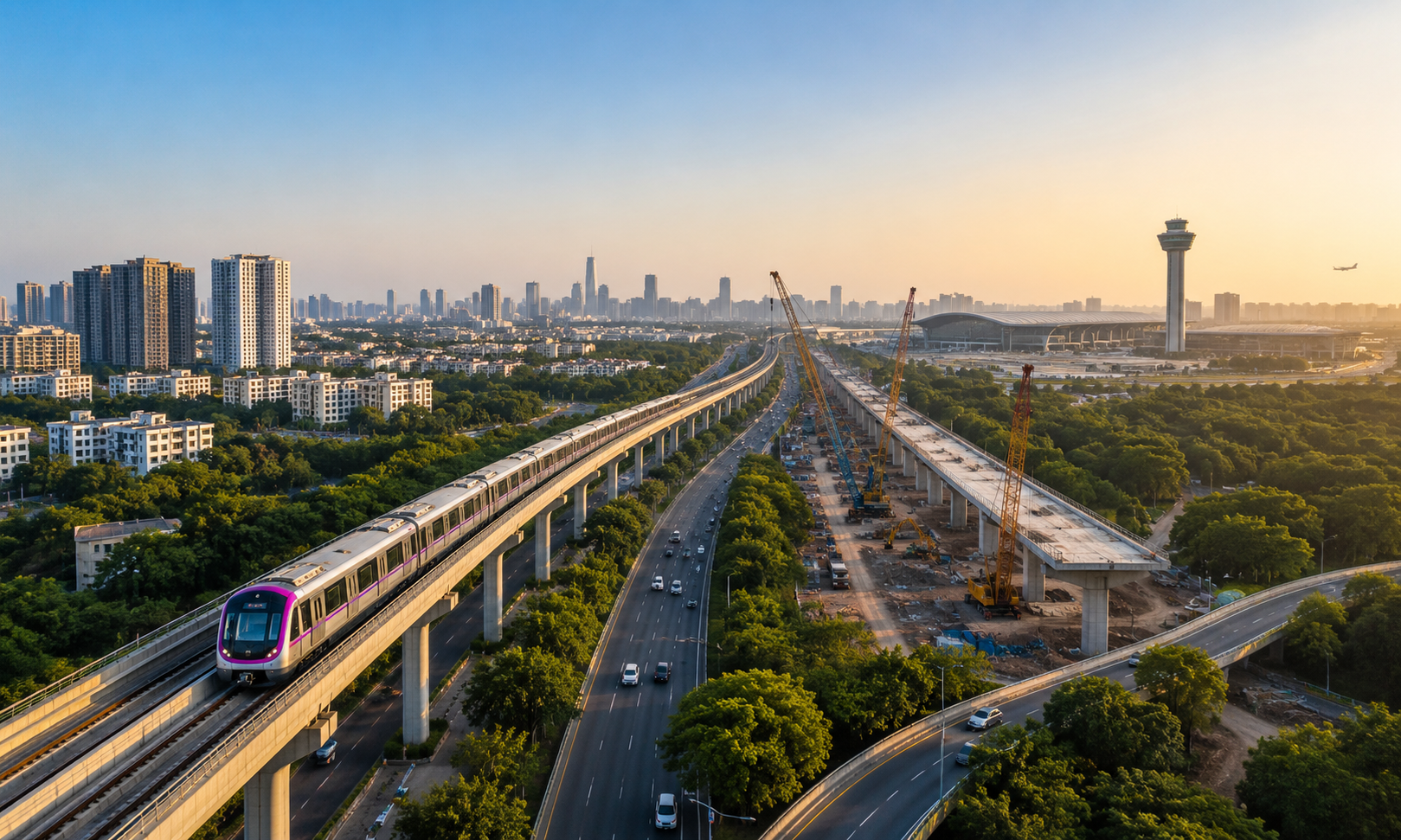
Bengaluru’s property market has historically been shaped by infrastructure development. Seven major projects that are under construction or active planning are expected to improve connectivity, reduce commute times, and influence residential demand across key corridors through 2035.
The projects expected to have the greatest impact on Bangalore property prices through 2035 include Namma Metro Phase 2 and Phase 3, the Bengaluru Suburban Rail Project, Kempegowda International Airport’s expansion, the Bengaluru Business Corridor, and the Satellite Town Ring Road.
Based on current infrastructure development and market trends, Devanahalli, Whitefield, Sarjapur Road, Hennur, Thanisandra, Yelahanka, and Hoskote are among the areas expected to benefit the most through 2035. Buyers who track verified construction progress rather than announcements are generally better positioned to identify long-term growth opportunities through 2035.
Key Takeaways
- As of mid-2026, Namma Metro operates 96.10 km and 83 stations of network.
- The Bengaluru Suburban Rail Project spans 148 km across four named corridors. Full network completion is now targeted for March 2030.
- Kempegowda International Airport handled 44.47 million passengers in FY2025-26. Terminal 2 is fully operational, and total capacity is expanding toward 50 million passengers annually.
- The Bengaluru Business Corridor, formerly the Peripheral Ring Road, spans approximately 73.5 km and is under phased implementation.
- According to a Square Yards market study, property prices in North Bengaluru micro-markets including Devanahalli, Yelahanka, Thanisandra, and Bagalur rose between 69% and 133% since FY21.
- Every project on this list has experienced at least one timeline delay. Investors should plan a realistic holding period of 5 to 8 years for infrastructure-led decisions.
How Do Infrastructure Projects Increase Property Values in Bengaluru?
Accessibility is one of the strongest drivers of long-term property demand in Bengaluru. When a metro line, expressway, or suburban rail corridor closes the commute gap between a distant area and the city’s employment hubs, residential demand for that area grows. Growing demand draws schools, hospitals, and commercial activity into the zone. As demand increases and land availability becomes more limited, property values often appreciate over time.
Bengaluru has demonstrated this cycle across every decade of growth.
- Whitefield matured into a premier IT corridor once tech campuses and road access arrived together.
- Electronic City evolved into a mainstream residential and employment hub after improved road connectivity, including the Elevated Expressway, reduced travel times.
- The Outer Ring Road significantly improved accessibility and contributed to higher property values across its corridor after becoming fully operational.
The same mechanism now runs through six simultaneous infrastructure projects covering the north, east, and outer ring of the city.
Buyers who monitor verified project progress are generally better positioned to identify long-term growth opportunities before prices fully reflect new infrastructure.
How Will Namma Metro Phase 2 and Phase 3 Affect Property Prices in Bengaluru?
As of mid-2026, Namma Metro operates 83 stations across 96.1 km, making it India’s third-largest metro network, according to Bangalore Metro Rail Corporation Limited (BMRCL). The Bangalore Metro Rail Corporation Limited manages Phase 2’s Blue and Pink Lines, which carry the most immediate property implications.
Blue Line and Pink Line: Current Status and Direct Property Impact
The Blue Line covers 58.19 km and connects Central Silk Board to Kempegowda International Airport via the Outer Ring Road, Hebbal, and Yelahanka. According to a March 2026 report by The Hans India, the Blue Line has been pushed to 2027, while the Pink Line connecting Nagawara to Kalena Agrahara targets end of 2026.
Metro-adjacent properties in Bengaluru command a 10% to 20% premium over comparable non-metro locations. Properties within 1 to 2 km of upcoming Blue Line stations along Hebbal, Yelahanka, and the ORR belt have already seen increased buyer interest as construction progresses, according to market reports.
Metro Phase 3 and Phase 3A: The Longer-Horizon Property Case
The Central Government approved Namma Metro Phase 3 in August 2024 at Rs. 15,611 crore. The project will add 44.65 km of new elevated metro corridors across western Bengaluru. Pre-construction activities, including land acquisition, geotechnical investigations, and tendering, are underway, while the full construction schedule continues to evolve. Phase 3A, a 37 km corridor connecting Hebbal and Sarjapur, received Karnataka Cabinet approval in December 2024 and is awaiting Central Government clearance.
Phase 3 and 3A benefits operate on a 5 to 10 year horizon. Buyers considering Sarjapur Road and western Bengaluru today may benefit from entering before Phase 3A is fully operational, provided they evaluate project progress, legal approvals, and market conditions.
How Will the Bengaluru Suburban Rail Project Impact Real Estate?
The Bengaluru Suburban Rail Project is a 148 km commuter rail network managed by K-RIDE (Rail Infrastructure Development Company Karnataka Limited), a joint venture of the Ministry of Railways and the Government of Karnataka. The network runs four corridors named Sampige, Mallige, Parijaata, and Kanaka. According to Bengaluru Suburban Railway on Wikipedia, the Mallige and Kanaka corridors are currently under active construction.
According to the official K-RIDE blueprint, Corridor 2 (Mallige) officially connects Baiyappanahalli to Chikkabanavara (though Benniganahalli sits directly adjacent on the route). For strict accuracy, you can use Baiyappanahalli as the primary terminal.
Suburban rail differs from metro in scope. The Sampige Line connects KSR Bengaluru directly to Devanahalli Airport via Yelahanka, adding a dedicated rail option to a corridor that currently relies entirely on NH-44 road access. For buyers in Devanahalli, Yelahanka, and nearby areas, the Sampige Line is expected to improve commuter connectivity, strengthen rental demand, and support long-term property value growth.
How Is Kempegowda International Airport Expansion Driving North Bengaluru Real Estate?
Kempegowda International Airport in Devanahalli is India’s third-busiest airport, operated by Bengaluru International Airport Limited. According to Kempegowda International Airport, the airport handled over 44.47 million passengers in FY2025-26. Terminal 2, the 255,000 square meter “Terminal in a Garden,” is now fully operational and adds approximately 27 million passengers of annual capacity, pushing total throughput toward 50 million. Bengaluru International Airport Limited has also announced a net-zero carbon emissions target by 2035.
Airport expansion typically drives residential demand by creating employment across logistics, aviation, hospitality, and business services. Logistics, aerospace maintenance, business services, and hospitality jobs cluster around a growing aviation hub. That workforce then generates direct residential demand in the surrounding corridor.
According to a Square Yards market study, property values in Devanahalli, Yelahanka, Thanisandra, and Bagalur increased between 69% and 133% since FY21. Current apartment rates in the Devanahalli corridor range from Rs. 11,000 to Rs. 13,000 per sq ft in premium layouts, according to OneCity Property’s 2026 area guide. Explore Aakruthi Properties’ ongoing residential projects positioned within these high-growth zones.
How Will the Bengaluru Business Corridor and STRR Affect Property Prices?
Bengaluru Business Corridor: The 73.5 km Expressway That Unlocks the Outer Arc
The Bengaluru Business Corridor, renamed from Peripheral Ring Road in October 2025, is an 8-lane, 73.5 km expressway built by the Bangalore Development Authority. The corridor runs from Tumakuru Road to Hosur Road via Hennur, Old Madras Road, and Doddaballapur Road, eventually forming a 116 km ring with the existing NICE Road.
The Karnataka government approved revised landowner compensation packages in 2025 and 2026. The project is currently under phased implementation, with construction progressing package by package and timelines dependent on land acquisition and execution.
Hennur Road sits directly within the BBC’s alignment. According to recent market reports, residential property prices on Hennur Road vary by project, location, and developer, with many developments averaging around Rs. 10,000 per sq ft. The Outer Ring Road demonstrated how improved connectivity can support long-term property value growth, and market analysts expect the Bengaluru Business Corridor to create similar opportunities for Hennur and Thanisandra over time.
Satellite Town Ring Road: Already Operational in Key Sections
The Satellite Town Ring Road is a 280 km expressway built by the National Highways Authority of India to connect 12 satellite towns including Devanahalli, Doddaballapur, Hoskote, Sarjapur, and Kanakapura, bypassing the city core entirely. The first 80 km stretch from Dobbaspet to Hoskote has been operational and tolled since mid-2024. Remaining sections target completion between 2026 and 2028.
Hoskote is strategically positioned near the STRR corridor and the Bengaluru-Chennai Expressway, improving long-term regional connectivity. This combination positions Hoskote as a long-term investment corridor for buyers with a 6 to 8 year investment horizon. Explore Aakruthi’s upcoming projects for developments positioned near these outer arc corridors.
Which Bengaluru Areas Are Expected to Benefit the Most by 2035?
Devanahalli and North Bengaluru have multiple major infrastructure projects converging in one corridor, making them among Bengaluru’s strongest long-term growth areas: airport expansion, the Blue Line metro airport connection, and suburban rail via the Sampige Line. Property appreciation of 69% to 133% since FY21 already reflects this, and the pipeline continues building.
Whitefield is considered one of Bengaluru’s most established residential markets, offering stable demand supported by strong IT employment and metro connectivity. The Purple Line metro runs from Whitefield (Kadugodi) to Challaghatta. Apartment prices range from Rs. 7,000 to Rs. 13,200 per sq ft, making Whitefield better suited for end-users and rental income investors than for long-horizon capital appreciation.
Sarjapur Road benefits from strong IT employment demand and is expected to gain additional connectivity if the planned Phase 3A metro corridor is completed. Annual villa land appreciation has averaged 10% to 12% over the past three years, placing Sarjapur Road among Bengaluru’s most reliable mid-to-long-term investment corridors.
Hennur and Thanisandra offer mid-range entry points near the BBC alignment with growing employment anchored at Manyata Tech Park. Hoskote generally offers more affordable entry pricing than many established Bengaluru investment corridors, with an appreciation case built on STRR access, the Bengaluru-Chennai Expressway, and a proposed metro extension from KR Puram playing out over 6 to 8 years.
Infrastructure Project Timeline and Expected Property Market Impact
| Year | Project or Milestone | Expected Property Market Impact |
| 2026 | Yellow Line expected to open; Pink Line targeted subject to construction progress. | South and North Bengaluru corridor demand accelerates |
| 2027 | Blue Line (ORR to Airport) completes | Hebbal, Yelahanka, Devanahalli premiums strengthen |
| 2027 | BBC construction progresses under phased implementation. | Hennur, Thanisandra early appreciation begins |
| 2028 | Mallige Suburban Rail (partial) | North Bengaluru peripheral demand builds |
| 2030 | Full Suburban Rail Network | City-wide rental demand broadens across corridors |
| 2031 | Metro Phase 3 (Orange Line) | Western Bengaluru and industrial belt uplift begins |
| 2033 | Metro Phase 3A (Hebbal to Sarjapur) | Sarjapur Road and south Bengaluru corridor expands |
| 2035 | Integrated infrastructure fully operational | Long-term appreciation sustained across all major corridors |
Project Comparison: Infrastructure Timeline, Areas Benefited, and Likely Price Impact
| Project | Revised Timeline | Key Areas Benefited | Likely Price Impact |
| Metro Phase 2 (Blue + Pink Lines) | 2026 to 2027 | Hebbal, Yelahanka, ORR Belt | High |
| Metro Phase 3 (Orange Line) | May 2031 | Western Bengaluru, Peenya | Moderate to High |
| Metro Phase 3A (Hebbal to Sarjapur) | 2033 | Sarjapur Road, South Bengaluru | High (long-term) |
| Bengaluru Suburban Rail | 2028 to 2030 (phased) | Devanahalli, Yelahanka, Hebbal | Moderate to High |
| Kempegowda Airport Expansion | Ongoing through early 2030s | Devanahalli, North Bengaluru | Very High |
| Bengaluru Business Corridor | Under phased implementation | Hennur, Thanisandra | High |
| Satellite Town Ring Road | 2026 to 2028 (phased) | Hoskote, Doddaballapur | Moderate to High |
What Should Buyers Check Before Investing Near Infrastructure Projects?
Every project on this list has experienced at least one meaningful delay. The Blue Line metro moved from its earlier target to 2027. The Bengaluru Suburban Rail Project shifted from 2026 to March 2030. The BBC spent years stalled in land acquisition disputes before its 2025 relaunch. Buying near an announced project and expecting returns within 12 to 24 months is a high-risk approach.
Historically, Bengaluru has seen stronger property price growth as infrastructure projects move into advanced construction or become operational, although outcomes vary by location.
Beyond timeline risk, buyers must actively evaluate:
- Water supply status in peripheral zones, specifically Cauvery water connection approvals and BWSSB clearances
- RERA registration through the Karnataka RERA portal for all under-construction residential projects
- Land conversion certificates, BDA or BMRDA layout approvals, and a clean 30-year encumbrance history for plotted developments
- Builder track record on delivery quality, possession timelines, and post-handover maintenance
Infrastructure makes an address more accessible. Civic infrastructure and legal approvals make that address genuinely livable and legally secure. Both need to be in place for appreciation to translate into real buyer value.
Which Bengaluru Growth Corridor Matches Your Investment Goals?
Bengaluru is simultaneously building metro lines, suburban rail, airport capacity, outer expressways, and ring roads at a scale the city has never seen before. The 2026 to 2035 window will determine which corridors become the next generation of established residential zones.
Devanahalli and North Bengaluru are widely regarded as some of Bengaluru’s strongest long-term growth corridors, supported by multiple infrastructure projects converging in the region. Whitefield remains the city’s most resilient established residential corridor. Sarjapur Road carries long-term Phase 3A metro upside alongside strong current IT demand. Hennur and Thanisandra offer layered appreciation potential from the BBC and North Bengaluru’s employment growth. Hoskote holds a patient investor thesis anchored to STRR and expressway access.
Buyers who verify project progress through official sources such as BMRCL, K-RIDE, and NHAI, align their purchase with their investment goals, and adopt a long-term perspective are generally better positioned to benefit from Bengaluru’s infrastructure-led growth.
Explore Aakruthi Properties’ residential projects across Bengaluru’s growth corridors or connect with the Aakruthi team to align the right corridor with your investment timeline and goals.
Frequently Asked Questions
- Which Bangalore infrastructure projects are expected to increase property prices the most by 2035?
Kempegowda International Airport’s capacity expansion, Namma Metro Phase 2, and the Bengaluru Business Corridor have the strongest near-term property price documentation. Areas at the intersection of multiple projects, specifically Devanahalli (airport, metro, and suburban rail) and Hebbal (Blue Line and BBC alignment), tend to capture the strongest cumulative appreciation because employment growth, commute convenience, and road access all improve at once. Long-term through 2035, Metro Phase 3A’s Hebbal-to-Sarjapur corridor will add another layer to east and south Bengaluru corridors.
- Is Aakruthi Svanta near Whitefield positioned to benefit from upcoming Bangalore infrastructure?
Aakruthi Svanta, located near Soukya Road in the Whitefield belt, benefits from three active infrastructure layers: the operational Purple Line metro running from Whitefield to Challaghatta, the Bengaluru-Chennai Expressway’s Karnataka section active since December 2024, and the planned Satellite Town Ring Road alignment through the eastern corridor. Whitefield is Bengaluru’s most metro-connected IT residential zone, with consistent rental demand from the ITPB and EPIP Zone tech ecosystem making it a strong long-term hold for end-users and investors alike.
- What makes Aakruthi Roots and Rays near KR Puram a strategically positioned project in East Bengaluru?
Aakruthi Roots and Rays, located near KR Puram, sits at the junction of the Outer Ring Road, the Purple Line metro, and the Bengaluru-Chennai Expressway’s Karnataka section. KR Puram is also the proposed start of a 16 km metro extension toward Hoskote under Blue Line Phase 2B. This three-layer connectivity position, operational road access, existing metro, and an upcoming metro extension, makes KR Puram one of the most infrastructure-dense residential entry points in East Bengaluru at a more accessible price than core Whitefield.
- Can NRI buyers invest in Aakruthi Properties’ residential projects in Bengaluru’s growth corridors?
Yes. Under FEMA regulations, NRI buyers can purchase residential properties in India, including Aakruthi’s villa plot communities and residential layouts, through NRE or NRO account channels. Aakruthi Properties offers dedicated guidance for NRI investors, covering documentation requirements, RERA verification steps, Power of Attorney processes for remote buyers, and how to navigate Bengaluru’s property registration system from abroad.
- How does Aakruthi Properties select locations for residential projects in Bengaluru’s growth corridors?
Aakruthi Properties prioritizes corridors where infrastructure investment is verifiable and in active construction rather than only announced, where social amenities are already present or under committed development, and where land title clarity meets the highest legal standards. The positioning of Aakruthi Svanta in Whitefield and Aakruthi Roots and Rays near KR Puram reflects a clear preference for locations at the intersection of operational metro connectivity, national highway access, and proven IT employment density. Learn more about the development philosophy at Aakruthi.
- Should homebuyers invest in Bengaluru before or after infrastructure projects are completed?
Historically, many Bengaluru corridors have experienced stronger appreciation during active construction than after project completion, although outcomes vary by location and market conditions. At announcement, prices may reflect speculation disconnected from actual project progress. At completion, the market has typically already adjusted to reflect the new connectivity reality. Historically, many Bengaluru markets have experienced stronger appreciation during active construction than after project completion, although investment outcomes vary depending on location, demand, and project execution.. Always verify project progress through official sources, including BMRCL for metro, K-RIDE for suburban rail, and NHAI for expressways.
- How does the Kempegowda International Airport expansion specifically affect property prices near Devanahalli?
Airport capacity growth, with Terminal 2 operational and total throughput heading toward 50 million passengers annually, generates employment clusters in logistics, aerospace maintenance, business services, and hospitality. These clusters create direct and sustained residential demand in Devanahalli and the surrounding North Bengaluru belt. This is employment-led appreciation rather than speculative demand, which makes it more durable across economic cycles. KIA’s expansion is the single strongest structural driver behind North Bengaluru’s residential market through 2035.
- What is the real estate impact of the Bengaluru Suburban Rail Project on property buyers in North Bengaluru?
The Sampige Line connects KSR Bengaluru Station directly to Devanahalli Airport via Yelahanka, adding rail-based commuter access to a corridor currently dependent entirely on NH-44 road connectivity. Once operational, this line makes plotted developments and villa communities in Devanahalli and Yelahanka significantly more practical as primary residences. The expanded commuter pool broadens both the buyer market and the long-term tenant base for properties in this corridor, which is the direct mechanism through which suburban rail converts accessibility into sustained property appreciation.
- Which Bengaluru neighborhoods are the strongest emerging investment hotspots for the 2030 and 2035 horizon?
For a 2030 horizon, Hennur Road and Yelahanka offer the most layered near-to-mid-term case, anchored to the Blue Line metro and the Bengaluru Business Corridor. For a 2035 horizon, Hoskote, Budigere Cross, and the broader eastern STRR-Expressway belt represent the most compelling long-horizon opportunities. Hoskote combines STRR access, the Bengaluru-Chennai Expressway, and a proposed metro extension from KR Puram, offering lower entry pricing today than core corridors while carrying multiple infrastructure triggers converging over the next 6 to 10 years.
- What factors beyond infrastructure determine long-term property appreciation in Bengaluru?
Infrastructure improves an address’s accessibility, but builder reputation and delivery track record determine whether a project gets built as promised. Civic infrastructure quality, specifically water supply, sewage, and power access, determines whether a location is genuinely livable rather than just accessible. Legal title clarity, including RERA registration, layout approvals, and a clean encumbrance history, determines whether a buyer receives a marketable, legally unencumbered asset. According to Coldwell Banker South India’s 2026 market outlook, annual property appreciation in established Bengaluru corridors averaged 8% to 12%, and this range applies most reliably when infrastructure proximity, civic readiness, and legal clarity all align within the same project.