

Published by aakruthiproperties October 26, 2026
You’ve found a plot you like. The location works, the size is right, and the developer’s brochure says “approved layout” in big letters. But approved by whom?
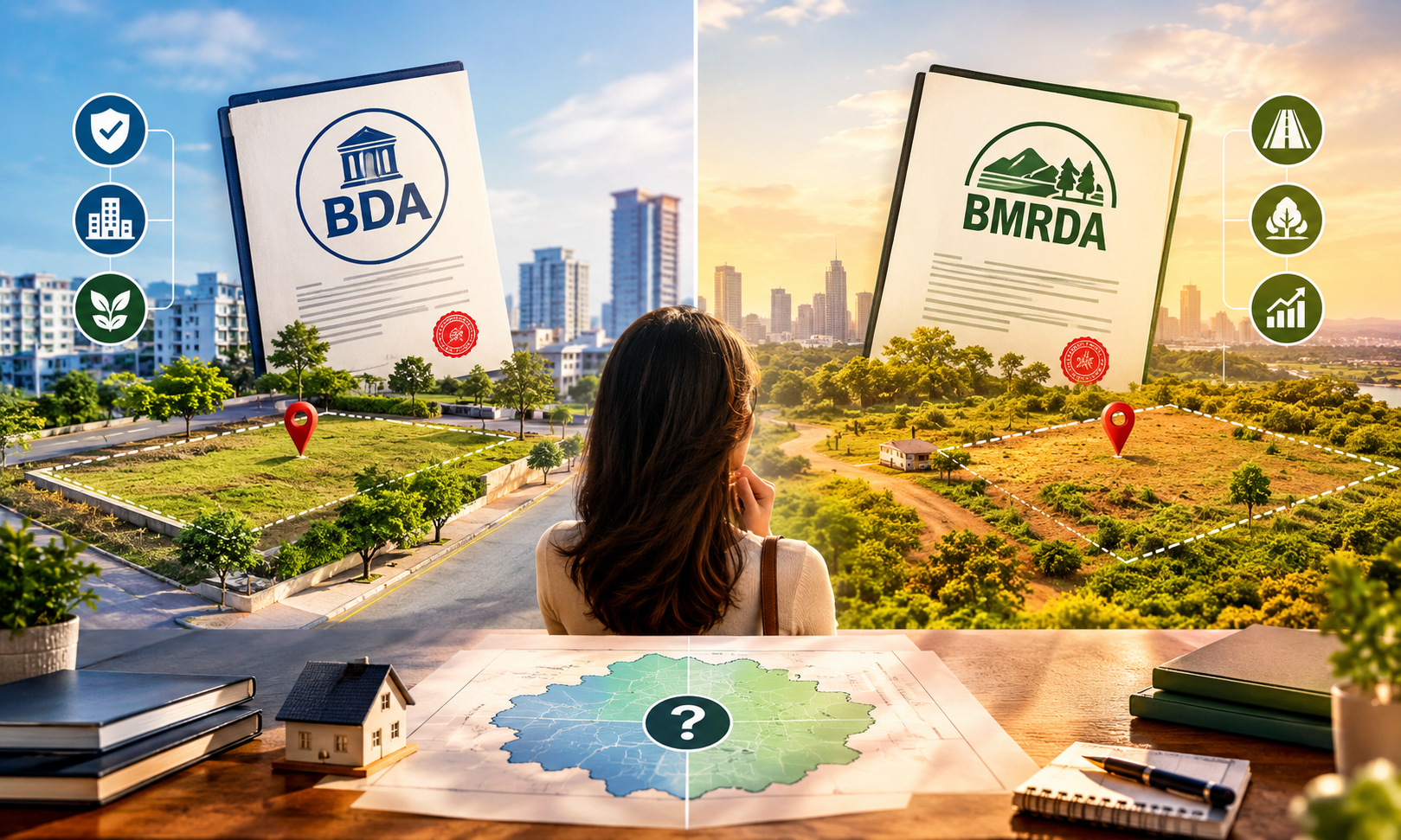
In Bangalore, this one question can shape your plot’s legal safety, your ability to get a loan, how easily you can build, and how much it’s worth when you decide to sell. Two names come up again and again: BDA and BMRDA. They sound similar, and sellers often use them casually, which leaves many first-time buyers confused.
This guide explains, in plain language, what each authority does, how plots approved by them differ, and what you should check before you pay a single rupee.
What Is BDA?
The Bangalore Development Authority (BDA) is the government body responsible for planning and developing the city of Bangalore and its immediate surroundings. It was set up under the BDA Act of 1976.
BDA does several things that matter to a plot buyer:
- It prepares the master plan for its area
- It forms and develops its own residential layouts, then allots sites to the public
- It approves layouts developed by private builders within its jurisdiction
- It decides land use and zoning in its planning area
Many of the well-known, established layouts in Bangalore, such as HSR Layout, Banashankari, and J.P. Nagar, were formed by BDA. More recently, it has developed layouts like Nadaprabhu Kempegowda Layout and Arkavathy Layout.
So when someone says a plot is “BDA approved”, it usually means it sits within BDA’s jurisdiction and the layout has gone through BDA’s planning and sanction process, or it’s a site formed by BDA itself.
What Is BMRDA?
The Bangalore Metropolitan Region Development Authority (BMRDA) was created under the BMRDA Act of 1985 to look after planning for the wider Bangalore Metropolitan Region. That region is much larger than the city and covers growing areas around it, including the outskirts of Bangalore Urban, Bangalore Rural, and parts of Ramanagara district.
Its role is bigger-picture. BMRDA prepares the regional master plan (the Revised Master Plan 2031 is the one most people refer to), coordinates development across agencies, and sets the framework for how land can be used and developed outside BDA’s area.
An important detail that many buyers miss: layout approvals in the BMRDA region are often handled through the local planning authorities that operate within its framework, in places such as Hoskote, Devanahalli, Anekal, Nelamangala, and Doddaballapur. So when a developer says “BMRDA approved”, the actual sanction letter may come from BMRDA or from the relevant local planning authority. Either way, you want to see the paperwork.
BDA vs. BMRDA at a Glance
| BDA | BMRDA | |
| Area covered | Bangalore city and its immediate periphery | The wider metropolitan region around Bangalore |
| Main role | Planning, forming layouts, allotting sites, sanctioning layouts | Regional planning and coordination, with layout sanction in its area |
| Typical plot locations | Established and planned layouts closer to the city | Growth corridors on the outskirts, such as Hoskote, Devanahalli, Anekal, and Nelamangala |
| Prices | Generally higher | Generally more affordable, with room for appreciation as infrastructure arrives |
| Infrastructure | Often planned and in place, or committed by the authority | Varies by layout and area, so it needs closer checking |
| Who it suits | Buyers wanting lower paperwork risk and quicker liveability | Buyers looking for value and long-term growth |
Use this as a starting point, not a final verdict. Every layout is different, and the individual approval documents matter more than the authority’s name.
The Key Differences Buyers Should Know
Jurisdiction: Where the Plot Sits
This is the most basic difference. BDA looks after the city and its planned periphery. BMRDA covers the larger region beyond it. Before anything else, find out which authority’s limits your plot falls under. The boundaries have shifted over the years as the city has expanded, so don’t assume. Ask the seller for the survey number and verify the jurisdiction yourself.
Who Approves the Layout
In BDA areas, BDA either forms the layout itself or sanctions a private developer’s layout. In BMRDA areas, layouts are sanctioned by BMRDA or by the local planning authority responsible for that area.
A layout with no sanction from the proper authority is considered unauthorized, no matter how good the marketing looks. And a gram panchayat approval is not a substitute for a proper layout sanction when the project requires one.
Prices
BDA-area plots usually come at higher prices because they’re closer to the city, better connected, and carry stronger buyer confidence. BMRDA-region plots are generally more affordable because they’re farther out, which is why many buyers and investors look at them for growth. That price gap can narrow when metro lines, expressways, and business corridors reach these areas, but it’s a mistake to buy only because something is cheaper.
Infrastructure and Livability
BDA layouts are generally planned with roads, parks, drainage, civic amenity sites, and utilities, and they often come with a more developed neighborhood around them. In BMRDA-region layouts, infrastructure depends heavily on the specific project and area. Some are well planned with wide roads, underground drainage, and water supply. Others are still catching up. Visit the site, walk the layout, and look at what exists today, not just what’s promised.
Khata and Documentation
Khata matters because it affects property tax, bank loans, and your ability to sell. In general, sites in properly approved layouts qualify for a clearer, more secure khata than unapproved ones. Karnataka has been moving khata records onto a digital system (e-Khata), so check that the plot’s khata is in order and matches the sale deed.
The type of khata and the process can differ depending on whether the plot is in a city corporation area or in a village or panchayat limit. Because rules and local practice vary, confirm the exact khata situation for your specific plot with a lawyer or the concerned office.
Building Plan Approval
Even in an approved layout, you can’t just start building. You need a building plan sanctioned by the relevant body. In BDA layouts, this goes through the civic authority for that area. In the BMRDA region, the sanctioning body could be the local planning authority, the gram panchayat, or another authority depending on the location. Ask which authority will sanction your building plan and what its timelines and fees look like.
Bank Loans
Banks lend against plots with clear titles and proper approvals. BDA-approved plots tend to get through bank verification more smoothly because the approvals are well known. BMRDA-approved plots can also be financed, but banks may scrutinize the layout sanction, the conversion order, and the khata more closely. If you plan to take a loan, ask your bank which documents it needs before you commit.
Resale and Liquidity
Plots in established BDA areas typically sell faster because buyers recognize and trust them. BMRDA-region plots can offer strong appreciation in growth corridors, but resale depends on how the area develops and how complete the layout is. A BMRDA plot with clean papers in a growing corridor can be an excellent investment. One with incomplete infrastructure or documentation can be hard to sell.
So, Which Is Better: BDA or BMRDA?
Neither is automatically better. It depends on what you want.
BDA approved plots may suit you if:
- You want a ready, established neighborhood
- Legal simplicity and bank financing matter most to you
- You plan to build soon and live there
- You’re comfortable with higher prices for lower risk
BMRDA approved plots may suit you if:
- You want more land for your budget
- You’re investing for the long term and can wait for infrastructure to mature
- You’re drawn to growth corridors with upcoming projects
- You’re willing to do careful due diligence on the layout
The real divide isn’t BDA versus BMRDA. It’s approved and verified versus assumed and unchecked. A properly verified BMRDA plot is a safer purchase than a BDA plot you haven’t looked into.
How to Verify a Plot Before You Buy
Whichever authority is involved, take these steps before paying a token amount.
- Ask for the layout sanction order. It should name the authority, give an approval number and date, and match the layout plan.
- Confirm it with the authority. Check the approval with the issuing office or its official list of approved layouts. Don’t rely only on the seller’s copy.
- Check the land conversion. Agricultural land must be converted for residential use, so ask for the conversion order.
- Trace the title. Review the mother deed and the chain of ownership for at least the past 30 years, and get an encumbrance certificate to confirm there are no loans or disputes.
- Verify the khata and tax records. Make sure the khata and tax receipts match the plot and the owner.
- Confirm RERA registration where applicable. If the layout is sold as a project, check that it’s registered with Karnataka RERA.
- Visit the site. Match the plot to the layout map, check road access, and look at the surroundings.
- Have a property lawyer review everything. This costs little compared with the risk of buying a problem plot.
Common Mistakes Buyers Make
- Trusting the tagline. “BDA approved” or “BMRDA approved” on a banner proves nothing. Ask for documents.
- Mixing up the two authorities. They have different roles, so make sure the claim matches the plot’s actual location.
- Ignoring conversion and khata. An approved layout can still have gaps in individual plot documents.
- Buying on price alone. A cheaper plot with weak paperwork often costs more in the end.
- Skipping the site visit. Photos and drone videos don’t show the real road width or surroundings.
- Not planning for construction approvals. Know who will sanction your building plan before you buy.
Looking for a Verified Plot in Bangalore?
Choosing between BDA and BMRDA approved plots becomes much simpler when you work with a developer who puts approvals and transparency first. At Aakruthi Properties, we focus on well-planned villa plot communities in Bangalore’s growth corridors, with documentation you can check and a team that’s happy to walk you through every step. Explore our villa plots in East Bangalore, look at our gated community villa plots in Bangalore, or visit aakruthiproperties.com to book a site visit.
Frequently Asked Questions
What is the main difference between BDA and BMRDA approved plots?
BDA looks after planning and layouts in Bangalore city and its immediate periphery, while BMRDA handles planning for the wider metropolitan region around it. In practice, BDA plots are usually closer to the city and priced higher, while BMRDA-region plots are further out and often more affordable.
Are BMRDA-approved plots safe to buy?
They can be, provided the layout has a valid sanction from BMRDA or the relevant local planning authority and the title, conversion, and khata are clear. Safety comes from verifying the documents, not from the label alone.
Are BDA approved plots always better than BMRDA approved plots?
Not always. BDA plots generally carry lower paperwork risk and stronger resale demand, but they cost more. BMRDA plots can offer better value and growth potential when the layout is properly approved and well developed.
How can I check if a layout is BMRDA approved?
Ask the developer for the layout sanction order and approval number, then confirm it with BMRDA or the local planning authority for that area. Checking the authority’s official list of approved layouts and having a lawyer review the documents is also wise.
How do I know if a plot falls under BDA or BMRDA?
Use the plot’s survey number to check which jurisdiction it falls under with the concerned authority. Jurisdiction boundaries have changed as Bangalore has grown, so confirm it instead of relying on the seller’s claim.
Can I get a bank loan for a BMRDA approved plot?
Yes, many banks finance plots in approved BMRDA-region layouts. They will usually check the layout sanction, land conversion, title, and khata, so keep these documents ready.
Do I need separate approval to build on an approved plot?
Yes. Layout approval covers the layout, not your house. You’ll still need a building plan sanction from the relevant authority before construction begins.
What is the difference between A khata and B khata?
In simple terms, A khata generally applies to properties in layouts and buildings that follow approvals and rules, while B khata is usually linked to properties with approval or regularization gaps. Rules and procedures have been changing, so check the current khata status of any plot you plan to buy.
Is a gram panchayat approval enough to buy a plot safely?
Generally no. Plots in a layout that requires sanction should have approval from the proper planning authority. Gram panchayat approval alone is not a safe replacement for that.
Final Thoughts
BDA and BMRDA are not rivals, and neither label guarantees a good purchase. They simply cover different parts of the Bangalore map and play different roles in how land is planned and approved.
If you want established surroundings and fewer paperwork worries, BDA areas are a natural fit. If you want more land for your money and are happy to invest in growth, BMRDA-region layouts are worth a serious look. In both cases, the same rule applies: check every document, confirm every approval, and take your time before you buy.
This article is for general information and is not legal advice. Rules, boundaries, and procedures can change, so confirm the details for any specific plot with the relevant authority and a qualified property lawyer.