

Published by aakruthiproperties July 29, 2026
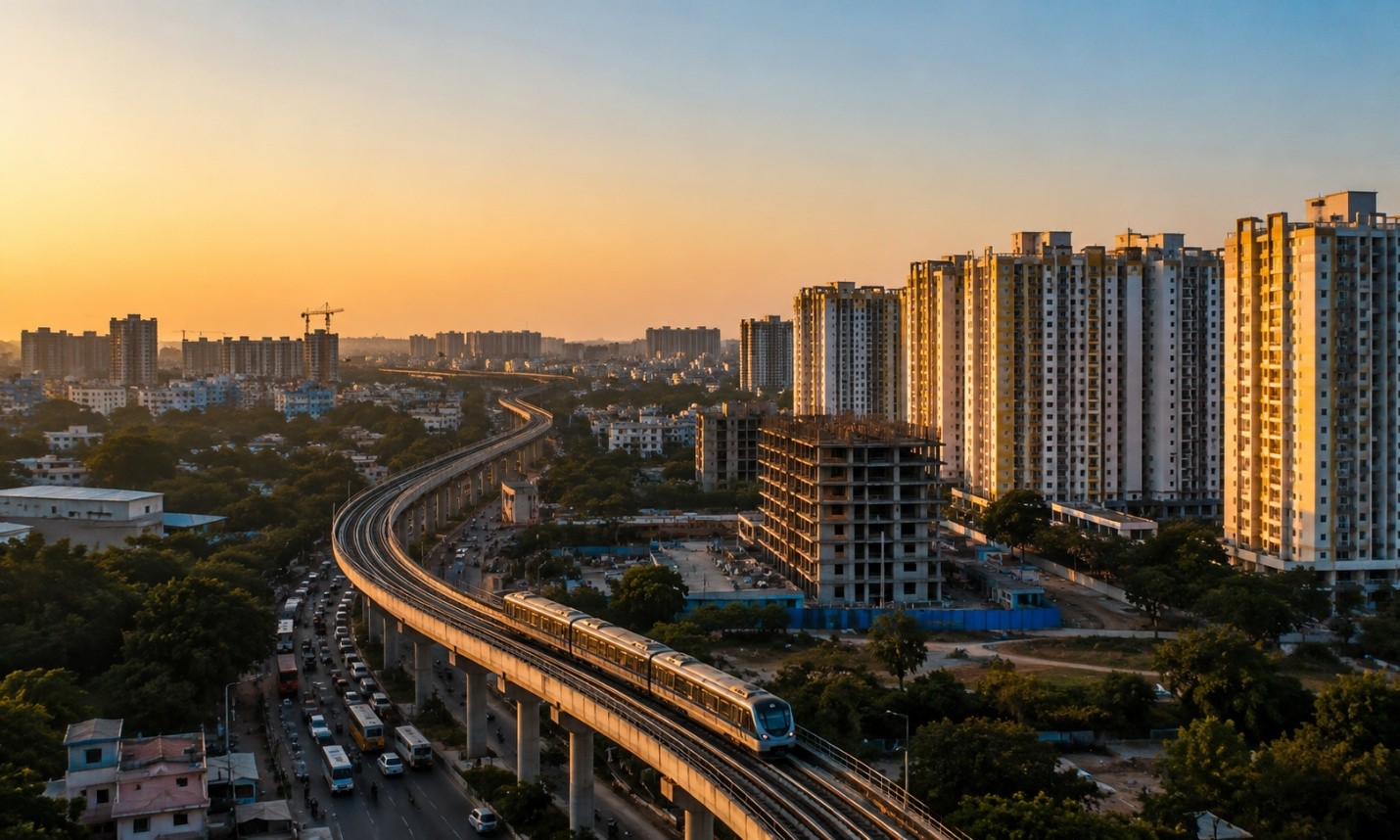
Drive down Whitefield Main Road on a weekday morning and you’ll see the story of East Bangalore in a single traffic signal: techies on their way to campuses that didn’t exist twenty-five years ago, cranes rising over half-built apartment blocks, and a metro train gliding past overhead on pillars that weren’t there a decade ago. This stretch of the city, once considered its outer edge, now accounts for more new residential launches than any other part of Bangalore. That shift didn’t happen by accident. It’s the result of three decades of IT-led employment growth meeting a slower, more recent wave of metro and road investment, and it’s why East Bangalore keeps coming up in conversations about where to buy a home or where to put money for the long term. This article looks at what’s actually driving that growth, where the opportunity lies, and where buyers need to be careful.
Why East Bangalore Has Become a Major Real Estate Growth Corridor
East Bangalore’s transformation traces back to the early 1990s, when International Tech Park Bangalore (ITPB), then known as ITPL, was set up in Whitefield as one of the country’s first integrated tech parks. That single development pulled in a wave of multinational technology companies over the following decades, and the EPIP Zone, Brookefield and Mahadevapura belt grew up around it. Employment created housing demand, housing demand created retail and social infrastructure, and that infrastructure in turn made the region more attractive to the next wave of companies and residents. It’s a self-reinforcing loop that’s still playing out today, extending further east into Hoodi, KR Puram and Kadugodi as land closer to the older IT parks has become scarcer and pricier.
Recent industry data reflects how far this expansion has gone. Cushman & Wakefield’s Q1 2026 Bengaluru residential market report noted that East Bangalore – spanning Whitefield, Gunjur, Budigere Cross and Hoskote – accounted for the majority of new residential launches in the city during that quarter. That’s a strong signal of where developers believe long-term demand is headed, though it’s worth remembering that launch volume reflects developer confidence and available land more than it guarantees future price performance for any individual buyer.
The Role of IT and Employment Hubs in Property Demand
The employment base anchoring East Bangalore’s residential market is genuinely large. ITPB alone has hosted decades of tenants including IBM, TCS, Wipro, SAP Labs, Oracle and Accenture, and the broader Whitefield–Mahadevapura belt now houses several hundred technology and multinational firms across formats ranging from large owned campuses to newer Grade-A leased towers. Global Capability Centres – in-house offices that multinational companies run for their own operations rather than outsourced work – have added a further layer of steady, well-paying employment to the corridor in recent years.
This matters for real estate because where people work still shapes where they choose to live, even with hybrid work now common. Shorter commutes remain a real preference for many professionals, particularly younger buyers and renters who value time over square footage. That preference shows up in two ways: strong rental demand from employees who want to live within a reasonable distance of their office, and steady end-user buying from professionals and families who eventually convert from renting to owning in the same general area. Both apartments and plotted or villa developments have found buyers here, with plotted communities in particular appealing to those who want long-term land ownership and more control over how they build.
How Infrastructure and Connectivity Are Shaping East Bangalore
Infrastructure is the second major driver, and it’s important to be precise about what’s actually built versus what’s still coming. Namma Metro’s Purple Line, which runs roughly 43 kilometres east-west across the city, is fully operational, with its eastern terminus at Kadugodi and stations serving Whitefield, Hoodi and KR Puram along the way. The Whitefield–KR Puram stretch has been running since early 2023, and it has measurably cut travel time between the IT corridor and the central business district compared with road-only commutes.
Beyond the Purple Line, several other projects are at different stages. The Blue Line, which will eventually connect KR Puram to Kempegowda International Airport via Silk Board and the Outer Ring Road, is under construction, with its first phase targeted for late 2026 and the airport-linked section expected in 2027 – these are project timelines, not guarantees, and East Bangalore residents don’t yet have this connectivity. Road projects including the Satellite Town Ring Road (STRR) and sections of the Peripheral Ring Road are in various stages of planning and construction and are intended to ease pressure on the Outer Ring Road over time. None of this should be read as complete; it’s a pipeline, and buyers should treat under-construction and proposed infrastructure as a factor to monitor rather than a reason to pay a premium today.
Whitefield: From IT Hub to a Major Residential Destination
Whitefield is the most mature part of this corridor, and it shows both the upside and the strain of three decades of rapid growth. On the positive side, it has an established IT ecosystem, operational metro connectivity through three stations, well-regarded schools such as Vydehi School of Excellence, hospitals including Manipal Hospital Whitefield, and retail anchors like Phoenix Marketcity. Housing stock ranges from older independent layouts to large gated apartment complexes and, further out toward Kadugodi, plotted villa communities such as Aakruthi Natureville and Natureville Beyond.
The strain is equally real. Whitefield’s growth outpaced road-widening and drainage upgrades for years, and residents and civic reporting consistently point to peak-hour congestion on stretches like Varthur Main Road and the Hope Farm junction, along with seasonal water scarcity in pockets that depend heavily on tanker supply rather than piped Cauvery water. The metro has eased some of this pressure but hasn’t eliminated it. Any honest assessment of Whitefield has to hold both realities together: it’s one of the most economically active parts of the city, and it’s also a locality where infrastructure has had to play catch-up with demand.
KR Puram and Hoodi: Strategic Locations for Residential Growth
KR Puram and Hoodi sit just west of Whitefield and have grown partly on their own merits and partly as an extension of Whitefield’s employment pull. KR Puram is a genuine multi-modal hub – it’s a Purple Line station, a railway junction, and the planned interchange point for the future Blue Line – which gives it connectivity advantages that go beyond what Whitefield itself offers. It’s also generally more affordable than the established core of Whitefield, which has made it attractive to buyers who want proximity to the IT corridor without paying Whitefield’s premium. Plotted development has found particular traction here; Aakruthi Roots & Rays, a villa plot community near KR Puram, is one example of the format gaining ground in this belt.
Hoodi, sandwiched between KR Puram and Whitefield along Whitefield Main Road, benefits from two Purple Line stations of its own and sits close enough to ITPL and the EPIP Zone to draw the same rental and end-user demand. It doesn’t have Whitefield’s decades of retail and social infrastructure yet, but that gap is narrowing as more residential projects come up along the corridor.
Kadugodi and Surrounding Areas: The Next Phase of Residential Development
Kadugodi, at the eastern terminus of the Purple Line, represents the newer edge of this growth corridor. Land here has historically been more available and more affordable than in core Whitefield, which has drawn larger-format residential and plotted developments, including Svanta by Aakruthi near Soukya Road. Metro access at the terminus station is a genuine advantage, and the area is seeing steady interest from buyers looking further ahead in their investment horizon.
That said, Kadugodi’s social infrastructure – schools, hospitals, organised retail – is still catching up to what’s available in established Whitefield, and it would be misleading to describe it as simply repeating Whitefield’s trajectory. Its growth depends on continued residential absorption and on infrastructure projects that are, at this stage, still being built out.
Why Homebuyers Are Considering East Bangalore
For end users, the appeal of East Bangalore is fairly practical. Professionals working in the IT corridor want to cut commute time, and living within or near the belt where they work does that. Families weigh the same factors alongside school options, hospital access and the availability of parks, malls and other daily conveniences, most of which are more developed in Whitefield than in the newer pockets further east. Community-oriented living matters too – gated apartment complexes and plotted villa communities both offer a sense of shared amenities and security that appeals to buyers moving from denser, older parts of the city. The range of housing formats, from compact apartments to independent villa plots, means the region can serve both younger professionals settling in for the first time and established families looking for more space.
Why Investors Are Interested in East Bangalore Property
The investment case for East Bangalore rests on a genuinely large and diversified employment base, ongoing infrastructure investment, and rental demand that has held up through multiple economic cycles. Knight Frank’s global residential research has repeatedly placed Bengaluru among the faster-appreciating prime housing markets internationally, and East Bangalore’s share of new launches suggests developers see continued absorption here.
That said, past appreciation in any micro-market does not guarantee future returns, and this region is no exception. Investors should weigh entry price against current market levels rather than headline growth figures from a few years ago, and should look closely at micro-location – proximity to an operational metro station or a functioning IT campus matters more than proximity to something still under construction. Developer track record, the legal status of the land, and realistic rental demand for the specific project all matter more than broad corridor-level narratives. Investment horizon matters as well: buyers looking to exit in two or three years face a different risk profile than those planning to hold for seven to ten years, particularly in the newer, less-established parts of the corridor. Our earlier piece on whether 2026 is the right time to invest in Bangalore real estate goes into this timing question in more depth.
East Bangalore Residential Projects: What Buyers Should Look For
Whether the format is an apartment or a plotted villa community, a basic due-diligence checklist holds up well across East Bangalore:
- RERA registration for the project, where applicable, and verification of the registration number on the Karnataka RERA portal
- Clear land title and chain of ownership, ideally checked by an independent lawyer
- All required statutory approvals from BBMP, BDA, BMRDA or the relevant local authority depending on the project’s location
- Developer track record on past project delivery and quality
- Actual road access and width leading to the project, not just what’s shown in marketing material
- Water supply source – piped Cauvery connection versus borewell or tanker dependence
- Drainage and stormwater provisions, particularly relevant given East Bangalore’s monsoon waterlogging history
- Electricity infrastructure and power backup arrangements
- Proximity to functioning schools, hospitals and daily-needs retail, not just planned ones
- Ongoing maintenance costs and who manages them post-handover
- Realistic resale and rental demand for that specific micro-location
For plotted developments specifically, buyers should additionally check plot dimensions against the sale deed, internal road widths within the layout, and whether drainage, water and electricity infrastructure is actually laid or still planned. Our guide for first-time buyers of villa plots walks through this process step by step.
East Bangalore vs Other Bangalore Real Estate Corridors
East Bangalore isn’t the only growth story in the city, and it isn’t automatically the right fit for every buyer. North Bangalore has grown around airport connectivity and large-scale planned development, with a younger overall market and longer average commute to established employment hubs. South Bangalore offers more mature social infrastructure and proximity to a different mix of IT and biotech employers, generally at a higher entry price given its established status. Central Bangalore commands a premium for location and legacy infrastructure but has limited fresh land available for new development.
Rather than declaring one region the best, it’s more useful to match the region to the buyer’s own priorities. Someone employed in the Whitefield–Mahadevapura IT belt with a medium-to-long investment horizon has good reason to look east. Someone whose workplace, budget or lifestyle preferences point elsewhere may find better value in North, South or Central Bangalore. Budget, workplace location, investment horizon and risk tolerance should drive the decision more than any single region’s reputation.
Key Risks and Challenges Buyers Should Consider
East Bangalore’s growth comes with real trade-offs that buyers should factor in rather than overlook. Traffic congestion on key stretches like the Outer Ring Road, Whitefield Main Road and Varthur Road remains a daily reality for many residents, even with metro connectivity in place. Water availability is a genuine constraint in parts of the region that rely on tankers rather than piped municipal supply, and this can affect both liveability and ongoing costs. Rising property prices in established pockets have narrowed the entry-price advantage that once made East Bangalore relatively affordable. Construction quality varies significantly between developers, which makes due diligence non-negotiable rather than optional. Legal verification of land title and approvals matters just as much in a fast-growing corridor as anywhere else, and buyers should be especially cautious about paying a premium for projects whose value depends heavily on infrastructure that is announced but not yet built.
Is East Bangalore a Good Place for Property Investment?
The honest answer is that it depends on who’s asking. Buyers seeking rental income from IT-sector tenants, or professionals wanting to live close to an established employment hub, are likely to find genuine value in Whitefield, Hoodi or KR Puram, where infrastructure is largely built and demand is proven. Investors with a longer horizon and higher risk tolerance may find opportunity in Kadugodi and similar emerging pockets, where prices are typically lower but returns depend more heavily on infrastructure that is still under construction.
Micro-location matters more than the broad “East Bangalore” label. A plot or apartment a few minutes from an operational metro station or a functioning tech park is a fundamentally different proposition from one that’s marketed on the promise of a road or rail line that hasn’t broken ground yet. A practical decision-making framework is to weigh current, operational infrastructure and demand most heavily, treat planned infrastructure as a bonus rather than the core investment thesis, and match the specific project’s format and price point to your own timeline and risk appetite rather than the corridor’s overall reputation. As always, property decisions should be based on individual financial circumstances, and buyers should seek appropriate legal and financial advice before committing.
Final Takeaway
East Bangalore’s growth is real and well documented: three decades of IT-led employment, a Purple Line Metro that’s fully operational across the corridor, and a residential market that developers are backing with a large share of the city’s new launches. Whitefield, KR Puram, Hoodi and Kadugodi each offer a different mix of maturity, price and risk, and none of them is a guaranteed win simply by virtue of being in East Bangalore. Buyers and investors who do the legwork – checking title, approvals, developer track record, water and road infrastructure, and realistic rental or resale demand for their specific project – are far better positioned than those relying on the region’s broader growth story alone.
FAQs
Is East Bangalore a good area for property investment?
It can be, particularly for buyers connected to the IT and employment corridor around Whitefield, Mahadevapura and KR Puram. The right answer depends on the specific project, micro-location and your investment horizon rather than the region as a whole.
Which are the best areas to invest in East Bangalore?
Whitefield, KR Puram, Hoodi and Kadugodi each offer a different balance of maturity and price. Whitefield has the most established infrastructure; KR Puram and Hoodi offer relatively better connectivity-to-price value; Kadugodi is earlier-stage with more upside and more uncertainty.
Why is Whitefield popular among property buyers?
Whitefield has one of Bangalore’s oldest and largest IT employment bases, fully operational metro connectivity, and established schools, hospitals and retail. It also comes with real challenges like traffic and seasonal water scarcity that buyers should weigh alongside the advantages.
Is KR Puram a good location for real estate investment?
KR Puram benefits from being a metro interchange, a railway junction and a planned Blue Line connection point, while generally being more affordable than core Whitefield. That combination has made it attractive for both plotted developments and apartments.
What factors are driving East Bangalore’s property growth?
The main drivers are sustained IT and multinational employment, operational metro connectivity along the Purple Line, ongoing road infrastructure projects, and steady demand from both end users and investors, reflected in East Bangalore’s large share of the city’s new residential launches.
Is East Bangalore suitable for first-time homebuyers?
It can suit first-time buyers who work in or near the IT corridor and want a range of housing formats and price points. First-time buyers should still budget time for due diligence on title, approvals and infrastructure rather than assuming all East Bangalore projects carry the same risk profile.
What should I check before buying a plot in East Bangalore?
Confirm RERA registration where applicable, verify land title and approvals independently, check actual plot dimensions against the sale deed, and assess whether water, drainage and electricity infrastructure is already in place rather than planned.
How does metro connectivity affect East Bangalore real estate?
Areas directly served by the operational Purple Line – Whitefield, Hoodi and KR Puram – generally see stronger demand and easier commutes than areas that depend on infrastructure still under construction or planned, such as the Blue Line or STRR.
Property prices, rental yields and infrastructure completion timelines change frequently. Figures and project statuses in this article reflect research as of July 2026 and should be independently verified before publication. This article is for informational purposes and does not constitute financial or legal advice.