

Published by aakruthiproperties June 26, 2026
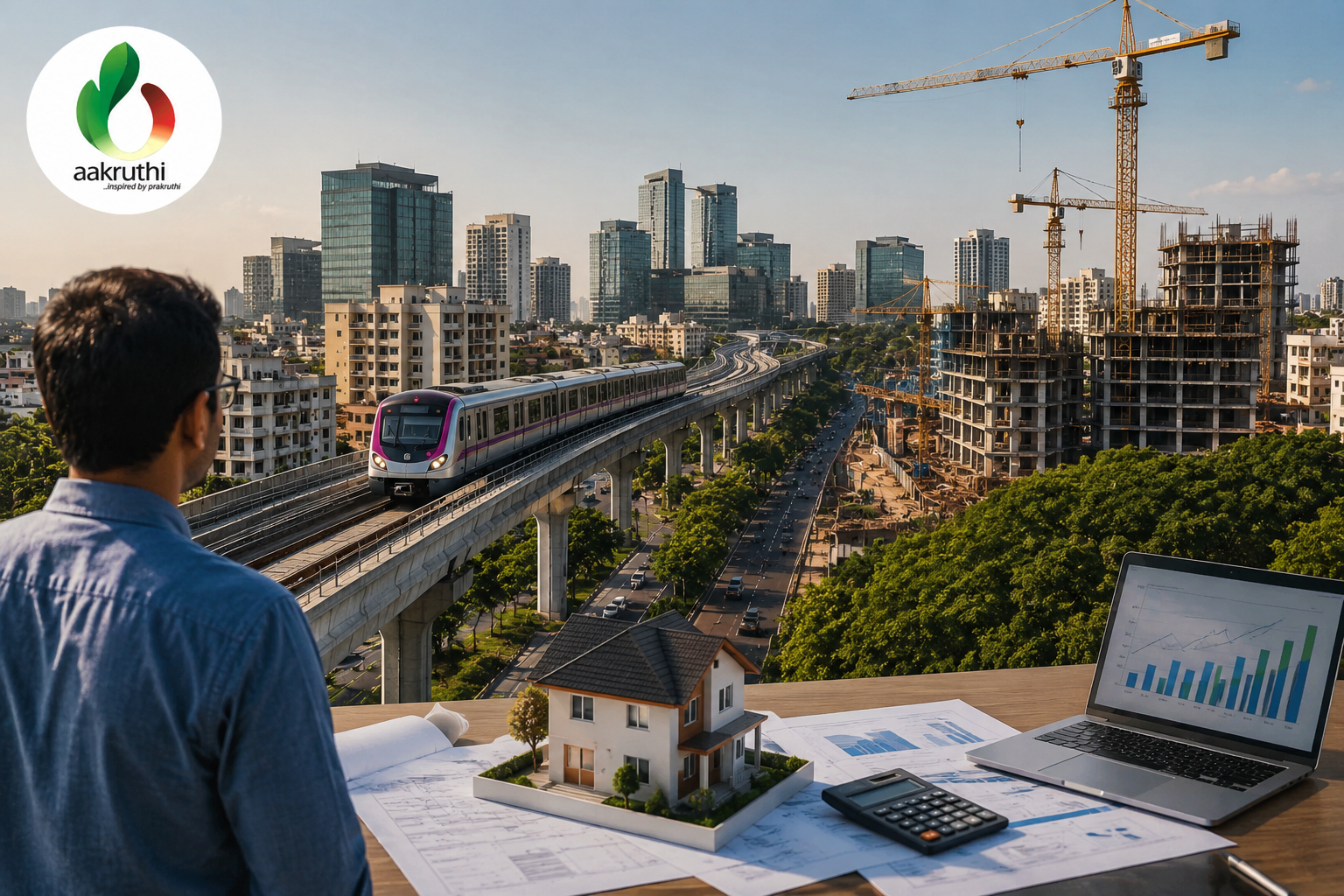
If you’ve driven through Bangalore in the last two years, you’ve probably noticed something. Cranes everywhere. New flyovers. Half-finished metro pillars that suddenly turned into running trains. And land prices in places nobody had heard of five years ago, now selling out within weeks of launch.
This isn’t random. It’s infrastructure doing what infrastructure always does, quietly rewriting the property map of a city.
For anyone thinking of buying a home, a plot, or an investment property in Bangalore in 2026, understanding these infrastructure projects isn’t optional anymore. It’s the difference between buying into the next growth corridor and buying into yesterday’s story.
This guide walks you through every major Bangalore infrastructure project shaping the market right now, the metro expansion, the Satellite Town Ring Road, the Bangalore-Chennai Expressway, the Bengaluru Business Corridor, the upcoming bullet train corridor near Kodihalli, and the IT parks rising around them. We’ll also cover where the smart money is moving, the mistakes first-time investors keep making, and how to make a decision you won’t regret in five years.
Why Infrastructure Increases Real Estate Prices
Let’s start with the basics, because this is the foundation for everything else in this guide.
Land itself doesn’t create value. Access does. A plot in the middle of nowhere is worth very little until a road connects it to jobs, schools, hospitals, and the rest of the city. The moment that connection happens, demand rises, and so does price.
Here’s the simple chain reaction:
- Better roads or metro lines reduce commute time. People are suddenly willing to live further from the city center because the journey doesn’t eat their whole day.
- Reduced commute time increases demand for housing in that location.
- More demand brings in shops, schools, hospitals, and offices. The area stops being “just residential” and becomes a self-sufficient neighborhood.
- Land becomes scarce as more people want in, and scarcity pushes up prices.
This pattern has repeated across Bangalore for decades. Whitefield was a quiet IT-adjacent suburb before the metro and the IT corridor matured. Sarjapur Road was agricultural land before the tech parks arrived. Electronic City was considered “too far” until the elevated expressway changed that conversation completely.
Did You Know? Areas near Bangalore’s Outer Ring Road saw property values rise by nearly 50% in the years after the corridor became fully functional, largely because IT companies anchored their offices along it. Infrastructure-led corridors tend to repeat this pattern, just in new locations each decade.
The pattern is consistent enough that real estate analysts now treat infrastructure announcements almost like an early signal. Of course, not every announced project gets built on time, which is exactly why this guide separates what’s operational, what’s under construction, and what’s still on paper.
Bangalore Metro Expansion: The Biggest Connectivity Shift in a Decade
The Bangalore Metro expansion, run by the Bangalore Metro Rail Corporation Limited (BMRCL), is probably the single biggest connectivity story in the city right now.
The Blue Line, which connects Central Silk Board to Krishnarajapura and onward to Kempegowda International Airport, is one of the most awaited stretches. It runs largely along the Outer Ring Road before heading north through Hebbal and Yelahanka toward the airport. This line alone is expected to transform property demand along the entire ORR-to-airport belt, since it directly links the city’s biggest job corridor to its biggest aviation hub.
The Pink Line, running from Kalena Agrahara in the south to Nagawara in the north, is another stretch that has investors watching closely. It passes through several established residential pockets and connects with both the Yellow Line and Purple Line, making cross-city travel far easier for residents who currently rely on cars or buses.
Beyond these, BMRCL has plans for a future Phase 4, which could eventually extend metro connectivity toward Hoskote, Bidadi, Harohalli, and even Tumkur. These corridors are still at the planning and approval stage, so it’s important not to confuse “proposed” with “under construction.” A proposed line is years away from changing ground reality. A line under active construction is a much safer bet for near-term appreciation.
What this means for buyers:
- Areas getting a metro station soon (within 1–3 years) usually see the steepest near-term price jump.
- Areas with only proposed lines may offer cheaper entry points, but carry more uncertainty and a longer wait for returns.
- Always check the live construction status before assuming a locality will “soon have a metro,” since timelines in large infrastructure projects often shift.
Satellite Town Ring Road (STRR): Opening Up Bangalore’s Edges
The Satellite Town Ring Road, commonly called STRR Bangalore, is a large ring highway being built by the National Highways Authority of India around the outer edge of the city. Once complete, it will stretch close to 280 kilometers and link satellite towns such as Devanahalli, Doddaballapur, Hoskote, Sarjapur, Anekal, Kanakapura, and Ramanagara.
Think of STRR as a bypass that lets long-distance and freight traffic skip the city entirely. That sounds like a trucking story, but for real estate, it’s much bigger than that. Whenever a satellite town gets fast, reliable highway access, it stops being a “far-off village” and starts being a viable place to live and work.
A meaningful stretch of STRR is already operational between Dobbaspet and Hoskote, with tolling active since 2024. This functioning section has already pulled real estate attention toward the northern and eastern satellite belt. The remaining sections, including the stretch toward the Tamil Nadu border, are progressing in phases, with some delays caused by environmental clearances near ecologically sensitive zones like Bannerghatta.
Here’s a point worth remembering: in real estate, a highway that’s actually open is worth far more than one that’s only announced. So when evaluating a location near STRR, ask specifically which stretch is functional today, not just what the full project promises for the future.
Practical Tip: If you’re comparing two plots near STRR, the one closer to an operational junction with an existing national highway will usually appreciate faster than one near a stretch still under construction.
Bangalore-Chennai Expressway: A Game Changer for the Eastern Corridor
The Bangalore-Chennai Expressway is one of the most significant inter-city projects in South India. Once fully open, it will cut travel time between the two cities from nearly six hours down to about three, running roughly 262 kilometers from Hoskote near Bangalore to Sriperumbudur near Chennai.
The Karnataka section of this expressway, covering roughly 71 kilometers, has already been operational since late 2024, improving access to areas like Malur and Bangarpet. The remaining stretches through Andhra Pradesh and Tamil Nadu are progressing in phases, with the full corridor expected to be functional sometime in 2026 or early 2027.
For real estate, this expressway does two important things:
- It strengthens Hoskote as a logistics and industrial gateway, since it now sits at the starting point of a major interstate corridor.
- It supports the broader Bangalore-Chennai Industrial Corridor, which is already pulling in manufacturing and logistics investment along the route.
Industrial growth doesn’t just create factory jobs. It creates demand for warehousing, worker housing, retail, and mid-segment residential projects in the surrounding belt. That’s exactly the kind of demand that tends to support steady, long-term property appreciation rather than short-term speculation.
Upcoming Bullet Train Station Near Kodihalli: A New Layer to the Eastern Corridor
Alongside the Bangalore-Chennai Expressway, there’s a newer, longer-horizon project worth watching in the same eastern corridor: a proposed bullet train (high-speed rail) station near Kodihalli, close to Hoskote. Following the Union Budget announcement of high-speed rail corridors linking Bengaluru with Chennai and Hyderabad, the National High Speed Rail Corporation Limited (NHSRCL) released preliminary alignment maps that show Kodihalli as a key stop on the route.
The proposed Bengaluru-Chennai high-speed rail corridor, running roughly 306 kilometers, is planned to start at Baiyappanahalli and pass through Whitefield, Kodihalli, and Kolar before crossing into Tamil Nadu. The separate Bengaluru-Hyderabad corridor is also expected to route through the same Kodihalli stretch, and early alignment work suggests a proposed Bengaluru-Mysuru high-speed line could eventually merge here too. If that plays out, Kodihalli could end up as a multi-corridor interchange rather than a single-line stop.
It’s important to be clear about where this project actually stands today. As of early 2026, it is still at the alignment and survey stage, with detailed project reports being prepared and land acquisition discussions just getting underway with the Karnataka government. There is no construction timeline yet, and high-speed rail projects in India have historically taken many years to move from announcement to operation. This is a project worth tracking over a 7–10 year horizon, not one to factor into a near-term buying decision.
For Hoskote and the wider eastern Bangalore-Chennai Expressway belt, a future bullet train interchange would add a third major connectivity layer on top of STRR and the expressway, reinforcing why this corridor already stands out in this guide’s appreciation outlook below. It’s an early-stage catalyst worth knowing about, even though it shouldn’t be the main reason to buy land today.
Peripheral Ring Road (PRR) — Now Officially the Bengaluru Business Corridor (BBC): The Most Talked-About, Most Delayed Project
If you’ve researched Bangalore infrastructure projects before, you’ve probably come across the Peripheral Ring Road. In October 2025, the Karnataka Cabinet officially approved the project and renamed it the Bengaluru Business Corridor (BBC), with Deputy Chief Minister D K Shivakumar confirming a revised compensation framework for landowners losing land to the corridor. It’s worth understanding clearly, because it’s also one of the most delayed.
PRR, now branded as the BBC, is planned as an 8-lane, roughly 73-kilometer expressway by the Bangalore Development Authority, designed to bypass the heavily congested Outer Ring Road. It will connect Tumakuru Road to Hosur Road via Hennur, Old Madras Road, and Doddaballapur Road, eventually forming a larger 116-kilometer ring together with the existing NICE Road.
The honest truth is that PRR has faced years of land acquisition delays. As of early 2026, the Karnataka government has approved revised compensation packages to speed up land acquisition, and officials are targeting the first phase for completion by around mid-2027, with the full project expected by the end of 2027.
This is an important lesson for investors: PRR is a real, government-backed project, but it has a long history of pushed deadlines. Buying land purely on the promise of PRR completion carries real timeline risk. That said, areas along its planned alignment, especially around Yelahanka and Hennur, are already seeing early interest from investors who are comfortable with a longer holding period.
Did You Know? The Outer Ring Road, which PRR is designed to relieve, currently handles over 10,000 trucks a day. That single statistic explains why PRR matters so much for the city’s long-term mobility, even though its construction has taken far longer than originally planned.
Upcoming IT Parks and Employment Hubs
Roads and metro lines matter, but jobs are what actually fill homes. Bangalore’s next wave of IT and business park development is moving in two clear directions.
Direction one: expansion of existing corridors. Whitefield, the Outer Ring Road belt, Bellandur, Marathahalli, and Sarjapur Road continue to add office space because the ecosystem here is already mature, metro access, schools, hospitals, and a deep talent pool are all in place.
Direction two: growth around North Bangalore and the airport belt. Devanahalli is no longer just an airport town. It’s developing into a broader business district with aerospace, electronics, logistics, and IT investment regions taking shape around it. Projects like business parks near the airport and large integrated townships are turning this stretch into Bangalore’s next major employment corridor.
For buyers and investors, this matters in two different ways:
- Mature corridors (Whitefield, ORR, Sarjapur Road) offer lower risk and proven rental demand, but entry prices are already high.
- Emerging corridors (Devanahalli, Doddaballapur, parts of North Bangalore) offer a lower entry price and higher potential appreciation, but come with more execution risk if planned projects face delays.
A balanced portfolio often includes one property in a mature, income-generating location and one in an early-stage growth corridor for longer-term capital appreciation.
Areas Expected to See the Highest Appreciation
Based on the infrastructure projects covered above, a few corridors stand out for the next three to seven years:
- North Bangalore (Devanahalli, Yelahanka, Bagalur, Chikkajala): Benefiting from airport connectivity, upcoming business parks, and future metro and PRR access. This belt has already shown appreciation of 15–28% over the past few years in several micro-markets, driven largely by IT and aerospace investment.
- Hoskote and the eastern STRR-Expressway junction: Sitting at the meeting point of STRR and the Bangalore-Chennai Expressway, and now a proposed bullet train interchange near Kodihalli, this area is well placed for logistics and industrial growth, which usually brings steady residential demand in its wake.
- Sarjapur Road extension and surrounding villages: Already a strong IT-driven market, with future metro connectivity expected to add further depth.
- Doddaballapur and the STRR northern belt: Lower entry prices today, with upside tied closely to how quickly the remaining STRR stretches become fully operational.
This is exactly the kind of “well-planned community near emerging infrastructure” approach that established developers in Bangalore, including names like Aakruthi Properties, have focused on when designing villa plots and residential layouts along growth corridors — positioning buyers close to upcoming connectivity rather than only what exists today.
Tips for Choosing the Right Investment Location
Picking a location based on a single factor is one of the most common ways investors get this wrong. Here’s a more balanced approach.
Quick Investment Checklist
- Check the actual construction status of nearby infrastructure (operational, under construction, or only proposed)
- Verify land titles, conversion certificates, and approvals (RERA, BDA/BMRDA layout approval where applicable)
- Visit the site during both dry and rainy seasons to check for waterlogging or access issues
- Compare price per square foot with at least 3 nearby projects, not just one
- Assess distance to the nearest functional road or metro station, not just the announced one
- Check future zoning plans through the local development authority’s master plan
- Ask about resale demand and rental yield in the immediate neighborhood, not just the broader locality
- Factor in a realistic holding period of 5–8 years for under-construction infrastructure corridors
What Else Matters Beyond Infrastructure
- Developer track record: A project from a developer with a history of delivering on time and maintaining well-planned layouts reduces a lot of long-term risk, especially for plot investments where infrastructure within the layout itself matters.
- Social infrastructure: Schools, hospitals, and grocery access often lag behind road infrastructure by a few years. Factor this into your “livability timeline,” not just your “appreciation timeline.”
- Water and sewage planning: Many peripheral areas in Bangalore still depend heavily on borewells and tanker supply. Always ask how a layout plans to handle water before buying, especially for plotted developments.
Common Mistakes Investors Make
Even experienced buyers fall into these traps. Watching out for them can save years of frustration.
- Buying based on a project announcement alone. Many infrastructure projects in India face delays of 2–5 years beyond their original timeline. Always check current status, not just the original announcement.
- Ignoring legal due diligence in the rush to “get in early.” Emerging corridors often have a mix of converted and unconverted land. Skipping title verification here is far riskier than in established areas.
- Underestimating the holding period. Infrastructure-led appreciation rarely happens in 1–2 years. Most meaningful price movement happens over a 5–8 year window.
- Following the crowd to the same 2–3 “hot” localities. When everyone rushes to one corridor, entry prices rise fast, and the early-mover advantage disappears. Looking one step further out, toward the next connecting node, often offers better long-term value.
- Not checking water, drainage, and basic civic access. A plot can be perfectly located on a map and still be impractical to build on if water and drainage haven’t been planned properly.
- Confusing “near a highway” with “easy access to a highway.” Distance on a map doesn’t always match real-world access. A plot 2 km from STRR but with no direct service road can be harder to reach than one slightly further away with proper connectivity.
Future Outlook for Bangalore Real Estate
Bangalore’s growth story isn’t slowing down, but it is changing shape. The city is no longer expanding only outward from its core. It’s growing around new anchor points — the airport in the north, the STRR-Expressway junction in the east, and industrial corridors stretching toward both Chennai and the satellite towns.
Over the next five to seven years, expect:
- Continued decentralization of office space, with North Bangalore and the airport belt gaining a larger share of new commercial development.
- Gradual maturity of satellite towns along STRR, similar to how Whitefield and Electronic City matured over the previous two decades.
- Plotted developments and villa communities gaining popularity among buyers who want long-term appreciation with more control over construction timelines, particularly in emerging corridors where ready apartment supply is still limited.
- Tighter scrutiny on water, sewage, and civic infrastructure as both buyers and regulators pay closer attention to livability, not just connectivity.
None of this means every plot near every announced project will appreciate. It means the overall direction favors patient, well-informed investors over those chasing short-term speculation.
A Quick Summary Before We Wrap Up
Here’s the short version of everything covered above:
- Infrastructure drives real estate appreciation by improving access, which increases demand, which then increases price.
- The Bangalore Metro expansion, particularly the Blue Line to the airport and the Pink Line, is reshaping demand along the ORR and North Bangalore belt.
- STRR is already partially operational between Dobbaspet and Hoskote, opening up satellite towns to serious investor attention.
- The Bangalore-Chennai Expressway is boosting Hoskote and the wider industrial corridor toward Tamil Nadu.
- A proposed bullet train interchange near Kodihalli could add a further long-term layer to the same eastern corridor, though it’s still at an early planning stage.
- Bengaluru Business Corridor, remains a high-potential but historically delayed project promising, but not a project to bet your entire timeline on.
- North Bangalore, Hoskote, Sarjapur Road extension, and Doddaballapur stand out as the strongest appreciation corridors for the next several years.
- The biggest mistakes investors make involve chasing announcements instead of verified progress, and skipping due diligence in the rush to invest early.
Conclusion
Bangalore has always grown in waves, and infrastructure has been the tide that lifts each new corridor. The metro, STRR, the Chennai Expressway, and the Peripheral Ring Road — now rebranded the Bengaluru Business Corridor —, and the early-stage bullet train corridor near Kodihalli, are not separate stories. Together, they’re redrawing the city’s map, opening up land that was once considered too far, too rural, or too inconvenient.
The opportunity here isn’t in chasing every headline about a new road or rail line. It’s in understanding which projects are real, which are years away, and which locations sit at the genuine intersection of connectivity, livability, and long-term demand. Buyers who take the time to verify this, rather than relying on word-of-mouth or sales pitches, are the ones who tend to look back on their decision with satisfaction rather than regret.
Whether you’re a first-time buyer, an NRI investing from abroad, or a plot investor planning a five-year horizon, the fundamentals stay the same: check the facts, visit the ground, verify the paperwork, and give infrastructure-led growth the time it actually needs to play out.
Frequently Asked Questions
- Which Bangalore infrastructure project is best for real estate investment in 2026? There’s no single “best” project, since each one benefits different parts of the city. The Bangalore Metro expansion supports established corridors like North Bangalore and the ORR belt, while STRR and the Bangalore-Chennai Expressway open up satellite towns and eastern industrial zones. Match the project to the location you’re considering, not the other way around.
- Is it safe to invest in areas near the Peripheral Ring Road (Bengaluru Business Corridor), given the delays? It can be a reasonable long-term bet, but treat it as a 5+ year investment rather than expecting near-term gains. The project was officially approved and renamed the Bengaluru Business Corridor (BBC) by the Karnataka Cabinet in October 2025, with a new compensation framework for landowners. Land acquisition has progressed with new government approvals in 2026, but the project has a long history of pushed deadlines, so price in extra patience.
- What is the difference between STRR and the Peripheral Ring Road? STRR is an outer highway built by the National Highways Authority of India, connecting satellite towns and diverting long-distance traffic away from the city. The Peripheral Ring Road — now officially the Bengaluru Business Corridor — is closer to the city core, built by the Bangalore Development Authority, and designed mainly to relieve pressure on the Outer Ring Road.
- Are villa plots a good investment option along these new corridors? Villa plots can offer strong appreciation potential in emerging corridors, especially where ready apartment supply is limited. They also give buyers more flexibility over construction timelines. As with any plot purchase, verify title clarity, layout approvals, and civic infrastructure before buying.
- How long does it usually take to see returns after an infrastructure project is announced? Meaningful price appreciation typically follows construction progress, not the initial announcement. Most well-documented cases in Bangalore show the bulk of appreciation happening once a project is at least 50–70% complete or fully operational, which can take anywhere from 3 to 8 years from announcement.
- Which areas in Bangalore are best for NRI investors in 2026? North Bangalore (especially around the airport belt) and the Sarjapur Road extension tend to appeal to NRI investors because of strong rental demand, established developer presence, and clearer documentation processes. Always engage a local legal advisor for due diligence when investing remotely.
- Does proximity to a metro station always guarantee higher property value? Not automatically. Proximity helps, but factors like the metro line’s construction status, the quality of last-mile connectivity, and existing social infrastructure all influence how much value that proximity actually adds.
- What should first-time home buyers prioritize: infrastructure or livability? Both matter, but in different timeframes. Infrastructure affects long-term appreciation, while livability (schools, hospitals, daily conveniences) affects your day-to-day comfort right away. A balanced choice considers both rather than optimizing for one alone.
- How can I verify if an infrastructure project’s timeline is realistic before investing? Check official sources like NHAI, BMRCL, or the Bangalore Development Authority for the latest project status updates, rather than relying solely on real estate marketing materials. Cross-referencing government tender and progress reports is one of the most reliable ways to separate genuine progress from optimistic projections.
- Is Bangalore real estate still a good long-term investment in 2026? For buyers who do proper due diligence and choose locations aligned with verified infrastructure progress, Bangalore continues to offer strong long-term fundamentals, driven by IT and GCC employment growth, expanding connectivity, and steady housing demand. As with any market, returns vary significantly by micro-location, so broad city-level optimism shouldn’t replace location-specific research.